
Feeling a chill in the air or sweating through a heatwave? Your home’s comfort largely depends on one small but mighty device: your wall thermostat. These unsung heroes of our HVAC systems do more than just turn the heat or AC on and off; they can significantly impact your energy bill, daily comfort, and even your overall home efficiency. But with so many options out there, how do you choose the right one?
Whether you’re looking to upgrade an old, clunky dial, simplify your heating control, or finally take control of your energy usage, there’s a perfect wall thermostat waiting for you. From basic, no-frills models to more advanced programmable units, understanding what each offers is key.
We’ve rounded up five top-rated wall thermostats to help you make an informed decision. Let’s dive in and find the ideal temperature controller for your space!
Suuwer S701 Single-Stage Non-Programmable Digital Thermostat

If you’re after straightforward temperature control without the hassle of programming schedules, the Suuwer S701 could be your go-to. This non-programmable digital thermostat stands out for its simplicity and clear display, making it a favorite for those who prefer manual adjustments. It’s designed for conventional single-stage heating and cooling systems, offering reliable performance with a user-friendly interface that even includes a blue backlight for easy reading in any light. Plus, it’s often dual-powered, meaning it can run on batteries, which is super handy if you don’t have a common (C) wire.
-
Key Features
- Designed for Conventional Single-Stage Heating (Gas/Oil/Electric Furnace) & Air Conditioning (1 Heat/1 Cool)
- Large, clear backlit digital display with blue light for easy visibility
- Dual-powered by 24VAC or 2 AAA batteries (no C-wire often required)
- Accurate temperature control of +/-1-degree F
- Adjustable heat/cool swing set up (0.2°F to 2°F)
- 5-minute compressor delay protection (selectable ON/OFF)
- Low battery indicator
- 2-year worry-free warranty
-
Pros
- Very easy to read, especially for seniors, thanks to the large display and backlight.
- Simple, non-programmable operation is ideal for those who prefer manual control.
- Often doesn’t require a C-wire, simplifying installation for many homes.
- Precise temperature control ensures consistent comfort.
- Affordable and comes with a solid warranty.
-
Cons
- Crucial for compatibility: Does NOT work with multi-stage systems, HVAC heat pumps, PTACs, 3-wire hydronic, dual fuel/hybrid, or line voltage systems (like baseboard heaters). You must check your system type carefully.
- Requires careful reading of instructions for installation to ensure compatibility.
-
User Impressions
Customers frequently praise the Suuwer S701 for its hassle-free operation and clear display, noting it’s perfect for rental units or homes where complex programming isn’t desired. Many appreciate not needing a C-wire, making it an easy swap for older manual thermostats. However, users strongly emphasize the need to verify system compatibility before purchase to avoid installation issues.
Honeywell Home CT87K The Classic Round Manual Heat-Only Thermostat

Sometimes, simplicity is key, and no thermostat embodies that better than the iconic Honeywell Home CT87K. This round, heat-only manual thermostat is a timeless classic, beloved for its familiar design and straightforward operation. If you have a dedicated heating system and prefer to set your temperature with a simple dial rather than digital buttons or complex schedules, this mercury-free wonder is an excellent, reliable choice. Its decorative cover ring also helps hide any old wall marks, giving your space a clean look.
-
Key Features
- Classic round styling with a familiar, aesthetically pleasing design
- Decorative cover ring helps hide wall imperfections
- Precise temperature control of +/-1 degree F
- Easy to install and incredibly simple to use
- Mercury-Free design for environmental safety
-
Pros
- Iconic, retro design looks great in a variety of home decors.
- Extremely easy to operate with a simple turn-dial – no learning curve!
- Reliable and durable, built to last.
- Hides wall marks, making for a cleaner installation.
- Mercury-free, a safer and eco-friendlier option.
-
Cons
- Heat-only, so it won’t control your cooling system.
- Manual operation means no programming or advanced features.
- Not a digital display, which some users might prefer.
-
User Impressions
Users absolutely adore the CT87K for its nostalgic charm and “set it and forget it” simplicity. Many choose it specifically for its classic look and dependable performance, finding it perfect for cottages, workshops, or any space where a basic, reliable heat control is all that’s needed. Its ease of installation is also a frequently highlighted benefit.
Honeywell Home RTH221B Programmable Digital Thermostat
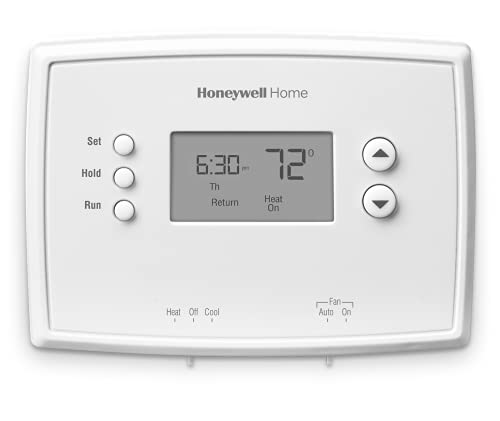
Ready to step up your energy savings without diving into a full-blown smart home system? The Honeywell Home RTH221B offers the perfect balance. This programmable digital thermostat allows you to set one identical program for the entire week, with four convenient periods per day (wake, leave, arrive, sleep). It’s a fantastic way to automatically adjust temperatures when you’re away or asleep, ensuring comfort when you need it and savings when you don’t. It’s user-friendly, precise, and a great entry point into scheduled temperature control.
-
Key Features
- One-week programming: Set an identical program for all 7 days with four daily periods.
- Precise temperature control of +/-1 degree Fahrenheit.
- Easy-to-read digital display with intuitive interface.
- Simple DIY installation.
- Built-in battery change reminders (requires 2 AAA batteries).
- Set point retained in memory during power outages.
- Display options for Fahrenheit or Celsius; 12 or 24 hour clock.
- Permanent and temporary override capabilities.
- Compatible with heating, cooling, and heat pumps without auxiliary heat options.
-
Pros
- Programmable scheduling helps save energy and money on utility bills.
- Digital display is clear and easy to read (though not backlit).
- Simple programming and installation, great for first-time programmable users.
- Battery backup ensures settings aren’t lost during power interruptions.
- Precise temperature control for consistent comfort.
-
Cons
- The display is not backlit, which can make it hard to read in low light.
- Only one program for the entire week (no individual day programming).
- Not compatible with electric baseboard heat (120-240V), heat pumps with backup, or multi-stage systems.
-
User Impressions
Users find the RTH221B to be an excellent upgrade from manual thermostats, appreciating its ability to automate temperature changes and contribute to energy savings. The simplicity of its weekly programming and straightforward interface makes it popular for those who want convenience without excessive complexity. The lack of a backlight is the most common minor complaint.
Honeywell Home CT410B Manual Line Voltage Thermostat for Baseboard Heaters
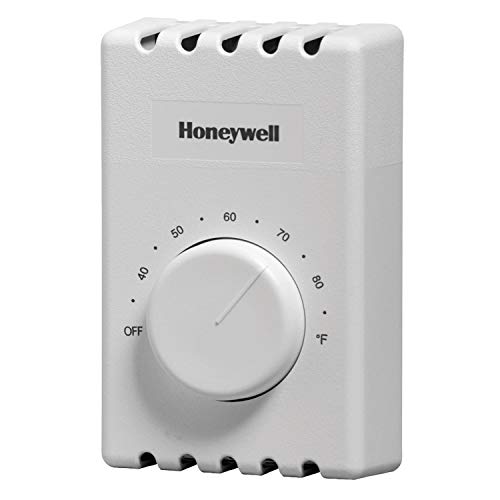
IMPORTANT: The Honeywell Home CT410B is a specialized wall thermostat designed for a very specific purpose: controlling line voltage heating systems like electric baseboard heaters, convectors, or fan-forced heaters. This is not for standard 24-volt central heating and air conditioning systems. If you have electric baseboard heating in a room or your entire home, this robust, non-programmable manual thermostat provides reliable, direct control. It features a bimetal temperature sensor for worry-free operation and a 4-wire double-line break for enhanced safety and positive OFF.
-
Key Features
- Non-programmable line voltage manual control (120-240 Volts).
- Compatible with electric baseboards, convectors, and non-inductive rated fan-forced heaters.
- Bimetal temperature sensor for simple, worry-free operation.
- 4-wire design provides double-line break for positive OFF and safety.
- Wide temperature range: 40°F to 80°F (4°C to 27°C). Heat Only.
- High power handling: up to 5280W @ 240 Vac (22A resistive).
- Can control multiple heaters if the combined load doesn’t exceed its capacity.
-
Pros
- Specifically designed for line voltage electric heating systems, where standard thermostats won’t work.
- Robust construction and reliable bimetal sensor.
- Double-line break ensures complete power disconnection for safety.
- High wattage capacity allows it to control multiple baseboard heaters.
- Simple, mechanical operation, no batteries or complex wiring (beyond line voltage).
-
Cons
- NOT for standard central HVAC systems. This is a critical distinction.
- Heat-only; does not control cooling.
- Manual and non-programmable, so no scheduling features.
- Requires 4-wire installation and understanding of line voltage wiring, which can be more complex than low-voltage.
-
User Impressions
Customers who need a line voltage thermostat highly recommend the CT410B for its reliability and direct control over electric baseboard heaters. They emphasize its specialized nature, cautioning buyers that it’s only for line voltage applications. Users appreciate its solid build and the peace of mind offered by the double-line break safety feature. It’s seen as a workhorse for rooms heated by electric baseboards.
Honeywell Home CT30A Basic Manual Heat-Only Thermostat

For those seeking the absolute simplest, most economical solution for basic heat control, the Honeywell Home CT30A is an unbeatable choice. This manual, heat-only thermostat gets the job done without any frills. It’s a no-fuss mechanical device, perfect for applications where you just need to set a temperature and forget about it. Think rental properties, garages, workshops, or any space where you simply want straightforward heating without worrying about programming or digital displays. It even includes a decorative back plate to cover existing wall marks.
-
Key Features
- Heat-only manual thermostat.
- Simple, worry-free operation.
- Reliable bimetal temperature sensor.
- Includes a decorative back plate to hide wall imperfections.
- Mercury-free design.
-
Pros
- Extremely affordable and economical.
- Incredibly simple to operate; anyone can use it.
- Reliable mechanical operation; no batteries or complex electronics.
- Comes with a back plate for a clean installation.
- Mercury-free.
-
Cons
- No off switch; you have to turn the dial all the way down to its lowest setting.
- Heat-only; no cooling control.
- Manual and non-programmable; no energy-saving schedules.
- Not digital, which some users might prefer.
-
User Impressions
The CT30A is lauded by users for its sheer simplicity and reliability. It’s often chosen for its “basic but effective” nature, particularly in situations where a digital or programmable unit would be overkill. Property managers frequently pick it for its durability and ease of use in rental units. Its main strength is its straightforward functionality and budget-friendly price point.
FAQ: All Your Wall Thermostat Questions Answered
Choosing the right wall thermostat can feel a bit overwhelming, but it doesn’t have to be! Here are some common questions to help clarify things.
Q1: What’s the main difference between programmable and non-programmable wall thermostats?
A: Programmable thermostats allow you to set schedules (e.g., warmer when you’re home, cooler when you’re away) to automatically adjust temperatures throughout the day or week, saving energy and money. Non-programmable (manual) thermostats require you to physically adjust the temperature setting whenever you want a change. They’re simpler but offer less automation for energy savings.
Q2: Do all wall thermostats need a “C-wire” (common wire)?
A: Not all of them! Many basic manual or non-programmable digital thermostats (like the Suuwer S701 reviewed above) can be powered by batteries, eliminating the need for a C-wire. However, most smart or Wi-Fi-enabled thermostats, and even some programmable digital ones, typically require a C-wire for continuous power to support their advanced features and connectivity. Always check product specifications.
Q3: Can I install a new wall thermostat myself, or do I need an electrician?
A: For most low-voltage (24V) thermostats used with central heating and cooling systems, installation can be a straightforward DIY project if you follow the instructions carefully and feel comfortable working with basic wiring. However, if you’re installing a line voltage thermostat (like for electric baseboard heaters), dealing with complex HVAC systems (e.g., multi-stage, heat pump with auxiliary heat), or are unsure about wiring, it’s always best to consult or hire a qualified electrician or HVAC technician for safety and proper function.
Q4: What is a line voltage thermostat, and why is it different?
A: A line voltage thermostat controls high-voltage (120V, 240V, or 277V) electrical heating systems directly, such as electric baseboard heaters, radiant floor heating, or fan-forced heaters. It’s different from low-voltage (24V) thermostats that control central HVAC systems. Using a low-voltage thermostat on a line voltage system, or vice-versa, will damage the thermostat and potentially create a safety hazard. Always ensure your thermostat matches your heating system’s voltage.
Q5: How can I choose the right wall thermostat for my home?
A: Consider these factors:
1. System Compatibility: Is your HVAC system single-stage, multi-stage, heat pump (with or without auxiliary heat), or line voltage? This is the most crucial factor.
2. C-wire availability: Do you have a C-wire, or do you need a battery-powered option?
3. Features: Do you want simple manual control, basic weekly programming, or advanced smart features (Wi-Fi, voice control)?
4. Display: Do you prefer digital with a backlight, or is a simple dial fine?
5. Budget: Thermostats range widely in price, so determine what you’re willing to spend.
Q6: How often should I replace my thermostat, and how long do they last?
A: A well-maintained thermostat can last 10-20 years, especially simpler manual models. However, you might consider replacing it sooner if:
* It’s not maintaining consistent temperatures.
* You want to upgrade to a more energy-efficient programmable or smart model.
* It’s old and mercury-based, and you want a mercury-free alternative.
* You’re experiencing issues like incorrect readings or failure to respond.
Q7: What is a single-stage HVAC system?
A: A single-stage HVAC system means your furnace (for heating) or air conditioner (for cooling) has only one operating capacity: either fully on or fully off. When it’s called to run, it operates at 100% capacity until the desired temperature is reached. This is the most common type of system and many basic wall thermostats are designed for it, like the Suuwer S701 and Honeywell RTH221B. More advanced systems might be multi-stage or variable-speed, which require compatible thermostats.
Conclusion
Choosing the right wall thermostat is more than just picking a pretty face; it’s about matching functionality with your home’s system and your lifestyle. Whether you prefer the timeless simplicity of a manual dial, the energy-saving benefits of basic programming, or a specialized solution for line voltage heating, there’s a perfect option out there. By understanding your specific needs and system compatibility, you’ll be well on your way to a more comfortable and energy-efficient home.

