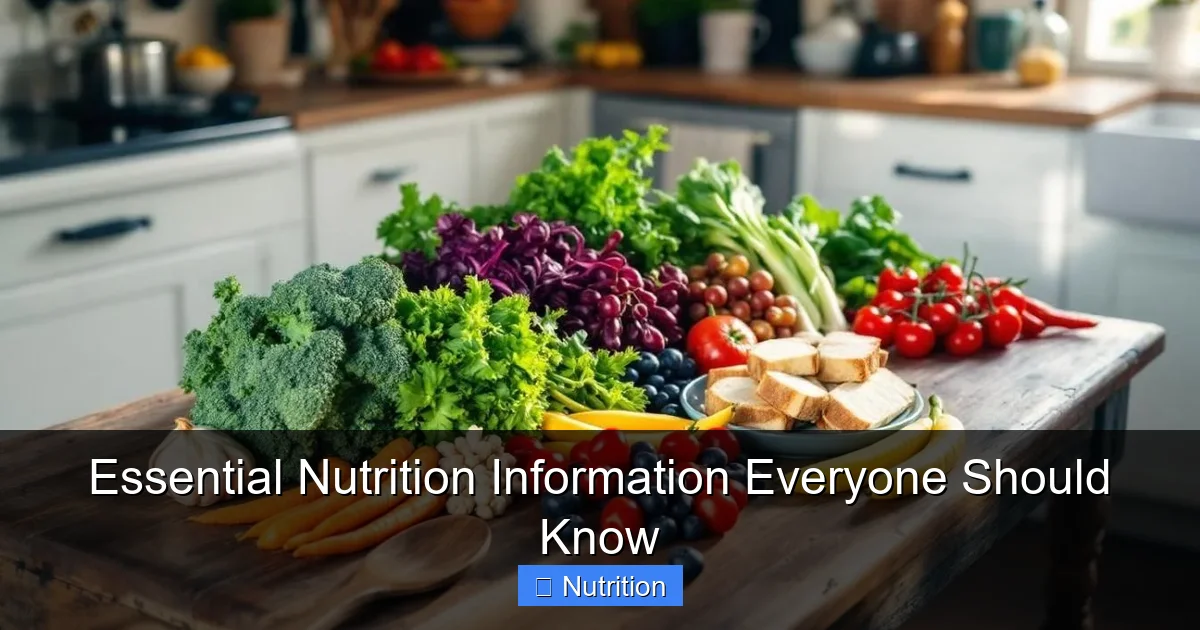
Featured image for this comprehensive guide about nutrition tracking
Image source: asja.org
<p>Have you ever felt like you’re eating “healthy” but not seeing the results you expect? Or perhaps you’re trying to achieve a specific fitness goal, but your progress feels stalled? The truth is, guessing what you eat can often be the biggest hurdle to reaching your health and wellness aspirations. This is where <strong>nutrition tracking</strong> steps in – a powerful tool that transforms vague intentions into tangible data, helping you understand precisely what’s going into your body.</p>
<p><strong>Nutrition tracking</strong>, often referred to as food logging or <strong>diet monitoring</strong>, is more than just <strong>calorie counting</strong>. It’s a comprehensive approach to understanding your dietary habits, identifying patterns, and making informed choices. It’s about gaining awareness, building accountability, and empowering yourself with the knowledge needed to optimize your health. However, like any habit, staying consistent and motivated can be challenging. Many start with enthusiasm only to abandon it a few weeks later.</p>
<p>This comprehensive guide will demystify <strong>nutrition tracking</strong>, exploring its benefits, various methods, and practical strategies to overcome common obstacles. Whether your goal is weight management, improved athletic performance, or simply <strong>healthy eating habits</strong>, we’ll equip you with actionable tips to maintain consistency, stay motivated, and ultimately achieve your <strong>nutrition goals</strong> for the long run. Get ready to transform your relationship with food and unlock your full potential!</p>
<h2>What is Nutrition Tracking and Why Does It Matter?</h2>
<p><strong>Nutrition tracking</strong> is the systematic process of recording and analyzing the food and beverages you consume over a period. At its core, it’s about making the invisible visible. Without <strong>food logging</strong>, it’s incredibly easy to underestimate caloric intake, overestimate nutrient density, and miss crucial patterns in your <strong>healthy eating habits</strong>. Research consistently shows that individuals who track their food intake are more successful at achieving and maintaining weight loss, managing chronic conditions, and improving their overall dietary quality.</p>
<p>The benefits of engaging in <strong>nutrition tracking</strong> extend far beyond mere numbers. It fosters a deep sense of awareness, allowing you to see how different foods impact your energy levels, mood, and physical performance. It provides concrete data to guide your decisions, taking the guesswork out of your diet. For instance, you might discover that your afternoon energy crash coincides with a high-sugar snack, or that you consistently miss your protein target on specific days. This invaluable insight is the foundation for sustainable change and true dietary mastery.</p>
<h3>A Glimpse into the Data: Understanding Your Plate</h3>
<p>When you start <strong>tracking your nutrition</strong>, you begin to uncover the hidden truths about your eating patterns. You might be surprised by the amount of sugar hiding in seemingly healthy foods or the hidden calories in your favorite condiments. This data-driven approach offers several key advantages:</p>
<ul>
<li><strong>Enhanced Awareness:</strong> You become acutely aware of portion sizes, ingredient lists, and the nutritional value of what you eat. This newfound awareness is the first step towards making more mindful and informed choices.</li>
<li><strong>Accountability:</strong> Knowing you need to log what you eat often creates a powerful sense of accountability, reducing impulsive snacking and encouraging adherence to your <strong>nutrition goals</strong>.</li>
<li><strong>Goal Achievement:</strong> Whether it’s weight loss, muscle gain, or managing a health condition, <strong>nutrition tracking</strong> provides the quantitative feedback necessary to adjust your intake and stay on target. It allows you to see if you are consuming appropriate <strong>calories</strong> and <strong>macros</strong> for your objectives.</li>
<li><strong>Pattern Identification:</strong> Over time, you’ll notice trends: which meals keep you full, which lead to cravings, or if stress triggers overeating. Identifying these patterns is crucial for long-term behavior change.</li>
<li><strong>Improved Dietary Quality:</strong> By seeing your nutrient breakdown, you can intentionally incorporate more vitamins, minerals, fiber, and diverse food groups, leading to genuinely <strong>healthy eating habits</strong>.</li>
</ul>
<h3>Beyond Calories: The Macro and Micro Story</h3>
<p>While <strong>calorie counting</strong> is often the most well-known aspect of <strong>nutrition tracking</strong>, it’s far from the only factor. A truly comprehensive approach also considers macronutrients and micronutrients:</p>
<ul>
<li><strong>Macronutrients (Macros):</strong> These are the nutrients your body needs in large amounts for energy and structural functions – carbohydrates, proteins, and fats. <strong>Macro tracking</strong> is particularly popular among athletes and those with specific body composition goals, as the ratio of these nutrients significantly impacts performance, satiety, and muscle growth. For example, ensuring adequate protein intake is vital for muscle repair and growth, while complex carbohydrates provide sustained energy.</li>
<li><strong>Micronutrients (Micros):</strong> These are vitamins and minerals, essential for countless bodily functions, even though needed in smaller quantities. While basic <strong>nutrition tracking</strong> apps may not give extremely detailed micronutrient breakdowns, many advanced platforms do. Tracking these can highlight potential deficiencies or areas where your diet could be more nutrient-dense, encouraging you to incorporate more fruits, vegetables, and whole grains.</li>
</ul>
<p>Understanding the interplay between calories, macros, and micros provides a holistic view of your diet, enabling you to fine-tune your intake for optimal health and performance.</p>
<h2>Choosing Your Nutrition Tracking Method: Apps, Journals, and More</h2>
<p>The landscape of <strong>nutrition tracking</strong> is diverse, offering a range of methods to suit different preferences and lifestyles. The key is to find a method that you find manageable, accurate, and, most importantly, sustainable. What works for one person might not work for another, so don’t be afraid to experiment until you find your perfect fit for <strong>diet monitoring</strong>.</p>
<h3>Popular Digital Tools for Easy Tracking</h3>
<p>For many, <strong>nutrition tracking apps</strong> are the go-to solution. They leverage technology to simplify the logging process and provide comprehensive data analysis. Here are some of the most popular options:</p>
<ul>
<li><strong>MyFitnessPal:</strong> One of the oldest and most widely used apps, boasting a massive food database, barcode scanner, and community features. It’s excellent for <strong>calorie counting</strong> and basic <strong>macro tracking</strong>.</li>
<li><strong>LoseIt!:</strong> Similar to MyFitnessPal, LoseIt! offers a user-friendly interface, barcode scanning, and personalized goals. Users often find its design intuitive and motivating.</li>
<li><strong>Cronometer:</strong> This app is renowned for its incredibly detailed micronutrient tracking, making it a favorite among those focused on comprehensive nutritional completeness. It provides a deeper dive beyond just <strong>macros</strong>.</li>
<li><strong>Fooducate:</strong> Besides <strong>food logging</strong>, Fooducate acts as a personalized nutrition coach, rating food quality and offering healthier alternatives.</li>
<li><strong>FatSecret:</strong> A free app with a large food database, barcode scanner, recipe ideas, and community support, ideal for beginners.</li>
</ul>
<p><strong>Pros of Nutrition Tracking Apps:</strong></p>
<ul>
<li>Vast food databases, often with barcode scanning for quick entry.</li>
<li>Automatic calculation of calories, macros, and sometimes micros.</li>
<li>Visual progress charts and analytical insights.</li>
<li>Sync with fitness trackers and other health apps.</li>
<li>Community support and motivational features.</li>
</ul>
<p><strong>Cons of Nutrition Tracking Apps:</strong></p>
<ul>
<li>Can feel overwhelming with too many features or data.</li>
<li>Accuracy relies on user-generated data for custom foods.</li>
<li>Some advanced features require premium subscriptions.</li>
<li>Can sometimes lead to an obsessive focus on numbers.</li>
</ul>
<h3>The Timeless Art of Manual Logging</h3>
<p>While digital tools are convenient, some prefer a more tactile and reflective approach to <strong>food logging</strong>.</p>
<ul>
<li><strong>Pen and Paper Food Journal:</strong> A simple notebook can serve as your <strong>nutrition tracking</strong> log. You manually write down everything you eat, including portion sizes. You can then use online resources to look up nutritional values and calculate totals.</li>
<li><strong>Photo Logging:</strong> Taking pictures of every meal and snack can be a quick and visual way to track your intake. While it doesn’t provide precise nutritional data, it offers a visual record that can help with portion control and identifying dietary patterns. Some apps specifically facilitate photo logging.</li>
</ul>
<p><strong>Pros of Manual Tracking:</strong></p>
<ul>
<li>Simplicity: No tech needed, no confusing features.</li>
<li>Mindful process: The act of writing can foster greater reflection and awareness of your choices.</li>
<li>Less distracting: No notifications or endless scrolling.</li>
</ul>
<p><strong>Cons of Manual Tracking:</strong></p>
<ul>
<li>Time-consuming for calculating total nutrients.</li>
<li>Less accurate for specific nutrient data without external resources.</li>
<li>Can be easy to forget or lose your log.</li>
</ul>
<p>When choosing your method, consider your tech comfort level, your specific <strong>nutrition goals</strong> (do you need precise micronutrient data or just general awareness?), and how much time you’re willing to dedicate. The best method is the one you’ll actually use consistently.</p>
<h2>Overcoming Common Challenges in Nutrition Tracking</h2>
<p>While <strong>nutrition tracking</strong> offers immense benefits, it’s not without its hurdles. Many individuals start strong but eventually face challenges that can derail their efforts. Recognizing these common roadblocks and having strategies to navigate them is crucial for maintaining your <strong>healthy eating habits</strong> and motivation.</p>
<h3>Streamlining Your Tracking Process</h3>
<ol>
<li><strong>Time Consumption:</strong> One of the biggest complaints is that <strong>food logging</strong> takes too much time.
<ul>
<li><strong>Solution:</strong> <strong>Batch logging and meal planning.</strong> Plan your meals and snacks in advance, and log them all at once. For recurring meals, save them as custom entries in your app. This can drastically reduce daily logging time. Many apps also allow you to copy meals from previous days.</li>
<li><strong>Solution:</strong> <strong>Use shortcuts.</strong> Leverage barcode scanners, voice input, and frequently used foods lists in your app. Pre-log your breakfast immediately after waking up, for example.</li>
</ul>
</li>
<li><strong>Accuracy Issues (Estimation & Food Labels):</strong> It can be hard to accurately estimate portion sizes or find precise entries for restaurant meals or home-cooked recipes.
<ul>
<li><strong>Solution:</strong> <strong>Invest in a food scale.</strong> For a few weeks, use a digital food scale to weigh your food. This will quickly train your eye to estimate portion sizes more accurately without needing to weigh everything long-term. Measuring cups are also helpful.</li>
<li><strong>Solution:</strong> <strong>Break down recipes.</strong> When cooking, log individual ingredients as you add them. If it’s a shared dish, estimate your portion and log the individual components that make up that portion. For restaurants, check if they publish nutritional information online; otherwise, choose the closest generic entry in your app.</li>
</ul>
</li>
</ol>
<h3>Maintaining a Healthy Mindset</h3>
<ol start=”3″>
<li><strong>Feeling Restrictive or Obsessive:</strong> For some, <strong>nutrition tracking</strong> can feel like a chore, leading to an unhealthy focus on numbers or guilt over “bad” foods.
<ul>
<li><strong>Solution:</strong> <strong>Focus on patterns, not perfection.</strong> Remember that <strong>nutrition tracking</strong> is a tool for awareness, not a stick to beat yourself with. One “imperfect” meal won’t derail your progress. Look for overall trends rather than obsessing over daily totals.</li>
<li><strong>Solution:</strong> <strong>Take breaks.</strong> If you feel overwhelmed, take a day or two off from strict tracking. Sometimes a mental reset is all you need. You can also transition to tracking only specific elements, like protein, for a period.</li>
</ul>
</li>
<li><strong>Losing Motivation:</strong> The initial excitement can wear off, making it hard to stick with the routine of <strong>food logging</strong>.
<ul>
<li><strong>Solution:</strong> <strong>Revisit your “why.”</strong> Remind yourself of your initial <strong>nutrition goals</strong> and the positive changes you’ve already experienced. Visualize your desired outcome. Review your progress charts to see how far you’ve come.</li>
<li><strong>Solution:</strong> <strong>Find an accountability partner.</strong> Share your goals with a friend, family member, or online community. Knowing someone is checking in can provide that extra push to <strong>stay consistent</strong>.</li>
</ul>
</li>
<li><strong>Social Situations:</strong> Eating out or at social gatherings can make <strong>nutrition tracking</strong> awkward or difficult.
<ul>
<li><strong>Solution:</strong> <strong>Plan ahead.</strong> If you know you’re eating out, check the menu online beforehand and pre-log your meal as best you can. Make mindful choices like opting for grilled instead of fried, or asking for sauces on the side.</li>
<li><strong>Solution:</strong> <strong>Estimate & move on.</strong> Do your best to estimate, or simply track the major components. Don’t let one meal derail your entire week. Enjoy the social aspect and get back on track with your next meal.</li>
</ul>
</li>
</ol>
<p>By proactively addressing these challenges, you can build resilience and ensure <strong>nutrition tracking</strong> remains a sustainable and empowering part of your health journey.</p>
<h2>Strategies for Consistency and Long-Term Motivation</h2>
<p>The true power of <strong>nutrition tracking</strong> lies in its consistency. Sporadic logging provides limited insight, but a regular routine creates a rich tapestry of data that can guide profound dietary changes. Developing strategies to <strong>stay consistent</strong> and <strong>stay motivated</strong> is paramount for long-term success. It’s about turning a task into a habit, and a habit into a lifestyle.</p>
<h3>Setting Yourself Up for Success</h3>
<ol>
<li><strong>Start Small and Simplify:</strong> Don’t try to track every single micronutrient from day one. Begin with just calories or just protein. Once you’ve mastered that, add another layer, like fats or carbs. You could even start by tracking just one meal a day for a week, then two. Gradual implementation reduces overwhelm and builds confidence.</li>
<li><strong>Set Realistic Goals:</strong> Your <strong>nutrition goals</strong> should be specific, measurable, achievable, relevant, and time-bound (SMART). Instead of “eat healthier,” aim for “track all meals for 30 days to identify protein intake patterns.” Unrealistic goals quickly lead to discouragement. Remember, progress is rarely linear.</li>
<li><strong>Integrate with Your Routine:</strong> Attach <strong>food logging</strong> to an existing daily habit. For example, log your breakfast while your coffee brews, or log your lunch during your afternoon break. Making it part of your established routine increases the likelihood of adherence. Apps with notification reminders can also be helpful.</li>
<li><strong>Embrace Meal Planning and Preparation:</strong> This is arguably one of the most effective strategies for seamless <strong>nutrition tracking</strong>. When you plan and prep your meals in advance, you know exactly what you’ll be eating. You can log all your planned meals at the beginning of the day or even the week, significantly reducing daily effort and decision fatigue. This is especially useful for <strong>macro tracking</strong>.</li>
<li><strong>Find Your Accountability Buddy:</strong> Share your <strong>nutrition tracking</strong> journey with a friend, family member, or join an online community. Regularly checking in with someone who shares similar goals can provide immense support and keep you motivated, especially when you feel like giving up. Many <strong>nutrition tracking apps</strong> have social features for this purpose.</li>
</ol>
<h3>The Power of Routine and Review</h3>
<ol start=”6″>
<li><strong>Focus on Progress, Not Perfection:</strong> It’s easy to get discouraged by an “off” day or a meal that didn’t align perfectly with your <strong>nutrition goals</strong>. Remember that consistency over time is far more important than daily perfection. If you miss a meal, just log the next one. If you have a high-calorie day, learn from it and move on. The data is for learning, not judgment.</li>
<li><strong>Celebrate Small Wins:</strong> Acknowledge and celebrate your achievements, no matter how small. Did you track for a full week? Did you hit your protein target for three days straight? Did you discover a new <strong>healthy eating habit</strong>? Positive reinforcement is a powerful motivator. This helps build a positive association with <strong>nutrition tracking</strong>.</li>
<li><strong>Regularly Review and Adjust:</strong> Set aside time weekly or bi-weekly to review your <strong>nutrition tracking</strong> data. What patterns do you see? Are you hitting your <strong>nutrition goals</strong>? Do you feel energized? Use these insights to make small, informed adjustments to your diet or tracking method. This iterative process keeps the journey engaging and ensures you’re always optimizing.</li>
<li><strong>Educate Yourself:</strong> The more you understand about nutrition, the more meaningful your tracking data becomes. Learn about the role of different macros, how specific foods impact your body, and the science behind <strong>healthy eating habits</strong>. This knowledge will fuel your motivation and empower you to make smarter choices.</li>
<li><strong>Know When to Take a Break (or Modify):</strong> If <strong>nutrition tracking</strong> starts to feel overly stressful or obsessive, it’s okay to step back. You might switch to tracking only one meal, or just focusing on portion control for a while. The goal is long-term sustainable health, not burnout. Sometimes taking a brief hiatus allows you to return with renewed vigor.</li>
</ol>
<p>By implementing these strategies, you can transform <strong>nutrition tracking</strong> from a temporary task into a lifelong skill, paving the way for lasting dietary improvements and a healthier you.</p>
<h2>Analyzing Your Nutrition Tracking Data for Optimal Results</h2>
<p>Logging your food is only half the battle; the real magic happens when you analyze the data. Your <strong>nutrition tracking</strong> logs are a treasure trove of information waiting to be deciphered. By regularly reviewing your entries, you can gain profound insights into your dietary patterns, identify areas for improvement, and make data-driven decisions that propel you closer to your <strong>nutrition goals</strong>. This analytical step is what truly differentiates mere <strong>food logging</strong> from effective <strong>diet monitoring</strong>.</p>
<h3>Interpreting Your Dietary Insights</h3>
<p>When you sit down to review your data, look beyond just the daily totals. Consider the broader context and potential correlations:</p>
<ul>
<li><strong>Caloric Intake Trends:</strong> Are you consistently within your target <strong>calorie</strong> range? Do you have recurring “high” or “low” days? For example, many people find their caloric intake spikes on weekends. Identifying this allows you to create strategies for balancing those days.</li>
<li><strong>Macronutrient Distribution:</strong> Are you hitting your protein, carb, and fat targets (if you’re <strong>macro tracking</strong>)? If you’re consistently low on protein, it might explain why you’re not feeling satiated or recovering well from workouts. If carbs are too high, it might be contributing to energy crashes.</li>
<li><strong>Micronutrient Gaps:</strong> Many advanced <strong>nutrition tracking apps</strong> show your intake of specific vitamins and minerals. Are there any consistent deficiencies? This can highlight areas where you need to incorporate more fruits, vegetables, or fortified foods.</li>
<li><strong>Food Sources and Quality:</strong> Beyond the numbers, what types of foods are you eating? Are your calories coming from nutrient-dense whole foods or processed items? <strong>Nutrition tracking</strong> helps you shift focus from just quantity to quality.</li>
<li><strong>Timing and Energy Levels:</strong> Notice how different meals affect your energy levels, focus, and mood. Does a big lunch make you sluggish? Does skipping breakfast lead to intense cravings? Linking your food intake to how you feel is powerful for optimizing your <strong>healthy eating habits</strong>.</li>
<li><strong>Hydration and Fiber:</strong> Most apps allow you to track water intake and fiber. These often-overlooked elements are critical for digestion, satiety, and overall health. Are you meeting your daily recommendations?</li>
</ul>
<h3>Making Informed Adjustments</h3>
<p>Based on your analysis, it’s time to make strategic adjustments. Remember, small, consistent changes are more sustainable than drastic overhauls.</p>
<ol>
<li><strong>Adjusting Calories/Macros:</strong> If you’re not seeing progress towards your weight goal, you might need to slightly increase or decrease your overall <strong>calorie</strong> intake, or adjust your <strong>macro ratios</strong>. For example, if you’re trying to build muscle, ensure you’re getting enough protein.</li>
<li><strong>Swapping for Nutrient Density:</strong> If your micronutrient data shows deficiencies, identify specific foods to incorporate. Instead of just “more vegetables,” perhaps target leafy greens for iron, or citrus for Vitamin C.</li>
<li><strong>Optimizing Meal Timing:</strong> Experiment with eating patterns. If you’re sluggish after lunch, try a smaller, protein-rich meal. If evening cravings are an issue, ensure you’re eating enough throughout the day.</li>
<li><strong>Addressing Emotional Eating:</strong> If your <strong>nutrition tracking</strong> reveals patterns of eating due to stress, boredom, or sadness, this awareness is the first step. You can then develop non-food coping mechanisms or seek support.</li>
<li><strong>Seeking Professional Guidance:</strong> If you’re struggling to interpret your data, have specific health concerns, or aren’t seeing desired results, consider consulting a registered dietitian or nutritionist. They can provide personalized advice, help you set appropriate <strong>nutrition goals</strong>, and refine your <strong>diet monitoring</strong> approach.</li>
</ol>
<p>The goal of analyzing your <strong>nutrition tracking</strong> data is to foster a continuous learning loop. You track, you analyze, you adjust, and you track again. This dynamic process ensures that your efforts are always aligned with your evolving health objectives.</p>
<h2>A Quick Comparison of Nutrition Tracking Methods</h2>
<p>To help you choose the best <strong>nutrition tracking</strong> method for your needs, here’s a brief comparison of the most common approaches. Each has its unique strengths and weaknesses, and the “best” method is ultimately the one you find most effective and sustainable for your <strong>diet monitoring</strong>.</p>
<table>
<thead>
<tr>
<th>Method</th>
<th>Pros</th>
<th>Cons</th>
<th>Best For</th>
</tr>
</thead>
<tbody>
<tr>
<td><strong>Nutrition Tracking Apps</strong> (e.g., MyFitnessPal, Cronometer)</td>
<td>Extensive food databases, barcode scanning, automatic calculations (calories, macros, some micros), analytics & charts, community features, reminders.</td>
<td>Can be overwhelming, accuracy relies on user-generated data, premium features often paywalled, potential for obsessive focus on numbers.</td>
<td>Tech-savvy individuals, those needing detailed insights into macros/micros, weight management, specific <strong>nutrition goals</strong>.</td>
</tr>
<tr>
<td><strong>Food Journal</strong> (Pen & Paper)</td>
<td>Simple & low-tech, promotes mindfulness, no screen time, flexible for notes on mood/feelings, free/low cost.</td
<td>Time-consuming for manual calculations, less accurate for specific nutrient data without external lookup, easy to lose, no automatic analysis.</td>
<td>Beginners, those seeking simplicity & introspection, individuals wanting to avoid screen dependence, focusing on mindful eating.</td>
</tr>
<tr>
<td><strong>Photo Logging</strong> (via apps or gallery)</td>
<td>Quick & visual record, less data entry, excellent for portion control awareness, useful for reviewing patterns without exact numbers.</td
<td>Lack of specific nutrient data, requires estimation, less useful for precise <strong>calorie counting</strong> or <strong>macro tracking</strong>, can be tedious to organize.</td>
<td>Visual learners, busy individuals, those focusing on general portion control and dietary variety, less emphasis on exact numbers.</td>
</tr>
<tr>
<td><strong>Mindful Eating & Intuitive Eating</strong></td>
<td>Focuses on internal hunger/fullness cues, non-restrictive, improves relationship with food, reduces stress around eating.</td
<td>Provides no quantitative data, harder to achieve specific <strong>nutrition goals</strong> (e.g., specific <strong>macro</strong> targets), requires a high degree of body awareness.</td>
<td>Individuals recovering from disordered eating, those looking to break free from diet culture, complementary to initial tracking phases.</td>
</tr>
</tbody>
</table>
<h2>Conclusion: Empower Your Health Journey with Consistent Nutrition Tracking</h2>
<p><strong>Nutrition tracking</strong> is far more than a passing trend; it’s a foundational practice for anyone serious about understanding and improving their health. By providing objective data on your eating habits, it empowers you to move beyond guesswork, identify crucial patterns, and make informed choices that align with your <strong>nutrition goals</strong>. From revealing hidden calories to highlighting micronutrient deficiencies, <strong>food logging</strong> acts as a personalized guide on your journey to optimal wellness.</p>
<p>While the path to consistent <strong>nutrition tracking</strong> may present its challenges, remember that it’s a skill that improves with practice. By choosing the right method, leveraging technology, and adopting strategies to <strong>stay consistent</strong> and <strong>stay motivated</strong> – like starting small, planning meals, and regularly analyzing your data – you can overcome common hurdles. Embrace this tool not as a restrictive chore, but as an opportunity for self-discovery and empowerment.</p>
<p>Ultimately, the goal isn’t to track forever, but to build an intuitive understanding of your body’s needs and cultivate sustainable <strong>healthy eating habits</strong>. <strong>Nutrition tracking</strong> provides the roadmap to get there. So, take the first step today. Choose a method, commit to consistency, and watch as your awareness grows, your choices improve, and your health transforms. Your journey to a more nourished, vibrant you begins now.</p>
Quick Answers to Common Questions
Why should I even bother with nutrition tracking?
Nutrition tracking helps you understand your eating habits and how they impact your goals, whether it’s weight loss, muscle gain, or just feeling better. It provides valuable insights you might otherwise miss!
How do I actually start nutrition tracking?
The easiest way to begin nutrition tracking is by using a dedicated app on your phone, like MyFitnessPal or Cronometer. Simply log what you eat and drink throughout the day.
What exactly should I be tracking?
For most people, focusing on calories and macronutrients (protein, carbs, fat) is a great start for nutrition tracking. Many apps also help you see micronutrient intake, which can be helpful too.
Won’t nutrition tracking take up too much of my time?
While it might seem like a lot at first, you’ll get much faster with nutrition tracking over time, especially with pre-logged meals and frequently eaten foods. Many find it takes just a few minutes a day once they get the hang of it.
What are the biggest benefits of consistent nutrition tracking?
Consistent nutrition tracking empowers you with knowledge about your body and diet, leading to smarter food choices and better results. It’s a powerful tool for achieving your health and fitness goals.
Frequently Asked Questions
Why is nutrition tracking beneficial for my health goals?
Nutrition tracking provides valuable insights into your eating habits, helping you identify areas for improvement and make informed dietary choices. It allows you to see how your food intake impacts your energy levels, weight, and overall well-being.

Learn more about nutrition tracking – Nutrition Tracking: How to Stay Consistent and Motivated
Image source: westoepractice.com
How can I stay consistent and motivated with nutrition tracking?
To maintain consistency, set realistic goals and start small, focusing on tracking just a few meals initially. Find an app or method you enjoy using and remember that progress, not perfection, is the key to long-term motivation.
What’s the easiest way to get started with nutrition tracking?
The simplest way to begin is by choosing a user-friendly app and logging everything you eat and drink for a few days without judgment. This initial period helps you establish a baseline and understand your current dietary patterns.
What should I do if I miss a day or forget to track my meals?
Don’t get discouraged if you miss a day; consistency doesn’t mean perfection when it comes to nutrition tracking. Simply resume your tracking with the next meal or day, and avoid letting a missed entry derail your overall progress.
Are there recommended tools or apps for effective nutrition tracking?
Many popular apps like MyFitnessPal, Cronometer, and LoseIt! offer comprehensive databases and features for logging food, water, and exercise. Choose one that aligns with your specific goals and offers a user-friendly interface for your daily use.
Is nutrition tracking something I need to do forever?
No, nutrition tracking doesn’t necessarily have to be a permanent endeavor for most people. Many use it temporarily to build awareness and develop healthier eating habits, transitioning to a more intuitive eating approach once they’ve gained sufficient knowledge and discipline.