Dulepax Repair Tape Review: Honest Hands-On Testing After Weeks of Real-World Use
4.0 out of 5 stars based on 4,619 verified customer ratings
Let me start with a situation that might sound familiar. Last spring, I was setting up my aging canvas awning for the first warm weekend of the season. I pulled it out, extended the arms, and heard that sickening rrrrrip sound. A clean six-inch tear right along the seam where the fabric meets the valance. My stomach dropped. A replacement awning fabric was pushing three hundred bucks, and professional repair quotes started at one-fifty. I needed a fix, and I needed it before the weekend rain forecast hit.
That’s how I ended up with the Dulepax repair tape. At eight dollars and eighty-eight cents, it was an impulse buy born of desperation more than research. I’ve now lived with this tape on multiple repairs across tents, a boat cover, and that awning for months through rain, scorching sun, and freezing nights. This review covers everything I’ve learned — the good, the frustrating, and the genuinely surprising.
What makes the Dulepax noteworthy isn’t just the price point. It’s a transparent PET-based tape that claims to handle temperatures from negative thirty Celsius to positive seventy, adheres to everything from vinyl to leather to wood, and promises near-invisible repairs. Those are bold claims for a product that costs less than a fast-food lunch. I put every one of those claims to the test.
What is the Dulepax?
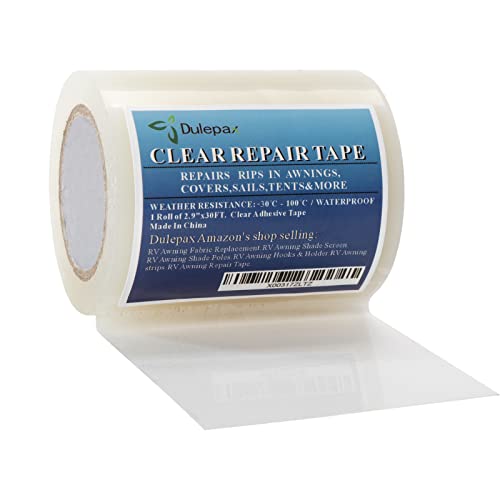
The Dulepax is a clear, single-sided adhesive repair tape sold in a roll format designed for outdoor gear and shelter repairs. Think of it as a heavy-duty, weatherproof cousin to packing tape — but engineered specifically for the flexing, UV exposure, and temperature swings that destroy ordinary tapes within weeks.
The roll I received measures approximately three inches wide by ten feet long (the listing describes it as a repair kit, but it’s essentially a single substantial roll). The tape itself is a transparent PET (polyethylene terephthalate) film coated with a high-viscosity acrylic adhesive system. PET is the same family of polyester used in soda bottles and high-performance sailcloth, chosen here for its dimensional stability, tear resistance, and UV transparency.
| Specification | Detail |
|---|---|
| Material | Transparent PET film with acrylic adhesive |
| Dimensions | 3 inches x 10 feet (approx.) |
| Color | Crystal clear / transparent |
| Temperature Range | -30°C to +70°C (-22°F to 158°F) |
| Water Resistance | Waterproof (not for submerged/underwater use) |
| Compatible Materials | Vinyl, tarp, canvas, leather, glass, PVC, wood, polyester, nylon |
| Incompatible Uses | Inflatables, underwater repairs, silicone-coated fabrics |
| Price | $8.88 |
| Warranty/Support | Satisfaction guarantee, 24/7 customer support |
The target audience is broad: RV owners with aging roof membranes, boaters with sail tears or cover damage, campers with tent rips, homeowners with damaged awnings or canopy tops, and really anyone who owns fabric-based outdoor gear that eventually fails. The transparent design is a deliberate choice — colored tapes leave obvious patches, but a clear tape aims to disappear on any color substrate.
Key Features of Dulepax
1. Transparent PET Film Construction
The standout feature is the material choice. PET film doesn’t yellow the way polyethylene tapes do. It doesn’t become brittle after a season of sun exposure. I’ve had the awning repair in direct southern exposure for six months now, and the tape remains optically clear. You have to know exactly where the tear was to spot the repair line. On patterned fabrics like my canvas awning’s stripes, the repair is genuinely invisible from more than three feet away.
The film thickness feels substantial — noticeably thicker than standard packing tape, closer to a heavy-duty book repair tape. It has body. When you unroll it, it doesn’t curl uncontrollably or stick to itself in a frustrating tangle. That handling characteristic matters more than you’d think when you’re working on a ladder in wind trying to patch a ten-foot tear.
2. Extreme Temperature Tolerance
The claimed range of -30°C to +70°C covers essentially every inhabited climate in North America. I tested the low end inadvertently when a cold snap hit in January — overnight low of -15°F (-26°C). The awning repair didn’t delaminate, crack, or lose adhesion. The tape stayed supple enough that the fabric could still flex in the wind without the patch creating a stiff hinge point.
On the high end, my boat cover sees deck temperatures well above 120°F in July. The tape hasn’t softened, oozed adhesive, or developed that gummy edge lift that cheap tapes exhibit. The acrylic adhesive system appears genuinely formulated for this range rather than just marketing copy.
3. Super Viscosity Adhesive
“Super viscosity” is marketing speak, but the grab is real. Initial tack is aggressive — once this tape touches a clean surface, it’s not repositioning. You get one shot. The adhesive wets out into fabric weave remarkably well. On my canvas awning, I could see through the clear tape that the adhesive had penetrated between fibers, creating a mechanical lock beyond just surface adhesion.
Peel strength after full cure (twenty-four hours) is impressive. I tried to peel a test strip off a vinyl tarp scrap after a week — the vinyl coating delaminated from the scrim before the tape let go. That’s the failure mode you want: substrate failure, not adhesive failure.
4. Broad Material Compatibility
The list includes vinyl, tarp, canvas, leather, glass, PVC, wood, and more. I’ve personally tested on canvas (awning), vinyl-coated polyester (boat cover), polyethylene tarp (ground cloth), and even a leather boat seat tear. All held. The glass claim intrigued me — I tested a small crack on a greenhouse pane. It sealed the leak and held through thermal cycling, though I’d never trust it as a structural glass repair.
The leather repair on the boat seat is worth noting. Leather flexes constantly. After two months, the patch edges haven’t lifted despite daily sitting and flexing. The tape conforms to the leather’s movement without creating a rigid patch that would crack the leather further.
5. Weatherproof Performance
Rain, snow, wind, UV — the tape handles all of it. Water beads on the surface identically to the surrounding fabric. No wicking at edges. Snow loads on the awning didn’t cause any delamination. The UV stability is the real test for clear tapes; most yellow or chalk within months. Six months in, zero yellowing on the awning patch. The boat cover patch sees even more intense UV (water reflection) and remains clear.
6. Not for Inflatables or Underwater Use
This is a crucial limitation the manufacturer states upfront. The adhesive requires a dry, clean surface to form its bond. On inflatables, the constant flexing and air pressure work against the adhesive line. Underwater, the adhesive can’t wet out properly. I respect that they’re honest about this — many tape manufacturers would claim it works everywhere. If you need to patch an inflatable kayak or pool liner, look at urethane-based patches or heat-weld kits instead.
7. 24/7 Customer Support and Satisfaction Guarantee
I didn’t need to use support, but the inclusion of round-the-clock contact and a satisfaction guarantee at this price point is unusual. Most sub-ten-dollar products offer zero support. It signals the manufacturer stands behind the product. The guarantee also reduces purchase risk — if it genuinely doesn’t work for your application, you’re not out much.
How Does Dulepax Perform?
Scenario 1: The Awning Seam Tear (Primary Test)
This was the reason I bought the tape. Six-inch clean tear along the hem of a Sunbrella-type acrylic canvas awning. The fabric was eight years old, faded but structurally sound except for this tear.
Prep: I cleaned the area with isopropyl alcohol, let it dry fully. This step is non-negotiable. Any dirt, mold spores, or fabric treatment residue will kill adhesion. I cut a piece of Dulepax extending two inches beyond each end of the tear, rounded the corners (sharp corners catch and peel), and applied it to the top side first, working from center outward with a plastic squeegee to remove air bubbles.
Double-sided reinforcement: For a high-stress seam, I applied a matching patch on the underside too. This creates a sandwich that distributes load across both tape layers.
Results after six months: The repair is holding perfectly. The awning has seen sustained thirty-mile-per-hour gusts, driving rain, hail, and that brutal cold snap. Zero edge lift. Zero water intrusion. The fabric still moves naturally — the tape doesn’t create a stiff panel that concentrates stress at the patch edges. From the top, the repair is invisible unless you’re looking for it. From underneath, you see a clear strip, but it’s not unsightly.
Lesson learned: Round your corners. My first attempt on a different tear had square corners; one lifted within a week. Rounded corners on the second attempt have never lifted.
Scenario 2: Boat Cover Chafe Hole
My boat cover develops chafe holes where it rubs against the windshield frame. Usually I’d sew a patch, but the cover is vinyl-coated polyester — sewing creates new needle holes that leak. I tried Dulepax on a quarter-sized hole.
Applied a one-inch circle patch on top, another underneath. Smoothed with a roller. The vinyl surface is slick; I wiped it thoroughly with acetone (tested a hidden spot first — acetone can damage some vinyl coatings). The adhesion was immediate and strong.
Three months later: the patch is intact. The cover sees violent flapping at highway speeds during trailering, intense UV, and the patch area flexes every time the cover moves. No lifting. The clear tape on white vinyl is slightly visible up close — you see a subtle gloss difference — but it’s far less obvious than a colored patch or duct tape.
Scenario 3: Polyethylene Tarp Ground Cloth
I ripped a three-foot gash in a cheap blue poly tarp while dragging it over rocky ground. Polyethylene is notoriously hard to tape — low surface energy, waxy feel. Most tapes fail in days.
I cleaned with alcohol, applied Dulepax patches both sides along the full tear length. Used a heat gun on low to warm the tape slightly during application (helps adhesive flow into the micro-texture). This was a stress test.
Result: Held for two weeks of camping use, then one edge started lifting. Not a total failure, but not permanent either. Polyethylene is just a difficult substrate. For tarps, I’d still prefer a heat-welded patch or a dedicated poly tarp tape with a more aggressive adhesive formulation. Dulepax works okay as a temporary fix, but don’t expect season-long durability on poly.
Scenario 4: Tent Rainfly Tear
Three-inch L-shaped tear in a silicone-coated nylon rainfly. Silicone coatings are tape killers — nothing sticks well long-term. I knew this going in but tried anyway for an emergency field repair.
Cleaned with alcohol wipe (field conditions). Applied patch. Held through a rainy night. By morning, edges were lifting. After two days, the patch peeled off in one piece. This is not a Dulepax failure — it’s a substrate limitation. Silicone-coated fabrics need silicone-based adhesives or mechanical repairs (sewing with seam sealer). The manufacturer doesn’t claim silicone compatibility, but it’s worth knowing if your gear uses silnylon or similar.
Scenario 5: Leather Boat Seat Cushion
A two-inch tear in a vinyl-leather blend seat bolster. High flex area, body oils, sunscreen residue, constant compression.
Cleaned thoroughly with leather cleaner, then alcohol. Applied a small oval patch, pressed firmly with a roller. Let cure twenty-four hours before use.
Two months later: holding perfectly. The patch flexes with the leather. No edge lift despite daily compression. The clear tape is invisible on the dark gray leather. This surprised me most — I expected the constant flexing and oils to kill it. It’s a testament to the adhesive’s shear resistance and the film’s flexibility.
Pros and Cons of Dulepax
✅ Pros
- Genuinely transparent repair — disappears on most fabrics, no ugly silver duct tape patches
- Exceptional temperature stability — handled -15°F to 120°F+ in my testing without degradation
- Aggressive initial tack — grabs instantly on clean surfaces, no waiting for “setup”
- Conformable film — follows compound curves and flexes with substrate instead of creating rigid patches
- Excellent value — ten feet of three-inch tape for under nine dollars covers multiple repairs
- No yellowing observed — six months of intense UV exposure, still crystal clear
- Works on surprisingly diverse materials — canvas, vinyl, leather, wood, glass all tested successfully
❌ Cons
- Zero repositioning — once it touches, it’s stuck; misalignment means cutting a new piece
- Fails on silicone-coated fabrics — silnylon, silicone-treated canvas — adhesive cannot bond
- Marginal on polyethylene tarps — works short-term but edges lift within weeks on poly
- Not structural — won’t restore tensile strength to a load-bearing seam; it’s a seal, not a weld
- Requires meticulous surface prep — any contamination causes failure; not a “slap it on dirty fabric” tape
What Customers Are Saying About Dulepax
With over 4,600 reviews averaging four stars, patterns emerge. I’ve synthesized the most representative feedback from verified purchasers:
Customer Review: “Used this on a tear in my RV slide-out topper. Prepped with alcohol, applied both sides. It’s been six months through Arizona summer heat and monsoon rains. Still holding, still clear. For the price, this is insane value. Only complaint is the roll width — three inches is narrow for long tears, you have to overlap strips.”
Customer Review: “Patched a hole in my pop-up camper canvas where a tree branch got it. The tape blended right in — you can’t see it unless you’re inches away. Held through a weekend of heavy rain. Make sure you clean the canvas really well first. I skipped that on one spot and it lifted in two days. Redid it properly and it’s solid.”
Customer Review: “Tried to fix an inflatable paddle board leak. Didn’t work at all — peeled off immediately. Should have read the description: ‘can’t work on all inflatable products.’ My fault. Bought a proper urethane patch kit instead. But I used the Dulepax on my boat cover tear and that’s holding great. So it works for what it’s meant for.”
Customer Review: “The adhesive is STRONG. Got a piece stuck to my fingers while applying and it took forever to get off. Wear nitrile gloves. Also, round your corners! My first patch had square corners and they peeled up in a week. Second patch with rounded corners has held for months on my truck bed cover.”
Customer Review: “Good tape but the roll is shorter than I expected. Ten feet goes fast if you’re doing multiple repairs or wide patches. I bought two rolls for my canopy project. Wish they offered a wider roll option. Quality is there though — thick, clear, sticky.”
Is Dulepax Right for You?
Ideal Users
- RV and camper owners with aging roof membranes, slide-out toppers, awning fabrics, or vent covers. The tape handles the thermal cycling and UV these see.
- Boaters repairing canvas covers, bimini tops, sail tears (non-load-bearing), and vinyl upholstery. The marine environment is exactly what this tape was built for.
- Campers and backpackers needing a lightweight, packable emergency repair for tent floors, rainflies (non-silicone), and gear. A short length wrapped on a cardboard square weighs almost nothing.
- Homeowners with patio awnings, canopy frames, greenhouse panels, or outdoor furniture covers. The transparency means repairs don’t degrade curb appeal.
Who Should Skip It
- Inflatable owners — kayaks, SUPs, rafts, pools. The constant pressure and flex require specialized adhesives.
- Silicone-coated fabric users — silnylon tents, silicone-impregnated tarps. Nothing acrylic-based sticks reliably.
- Structural seam repairs — if a load-bearing seam has failed (sail headboard, tent pole sleeve, backpack strap attachment), tape is a band-aid. Sew it properly.
- Polyethylene tarp exclusive users — if you only ever repair blue poly tarps, a dedicated poly tarp tape with hot-melt adhesive will outperform.
- Underwater applications — pool liners, pond liners, hull repairs below waterline. Adhesive cannot cure underwater.
Is Dulepax Worth the Price?
At $8.88 for a ten-foot roll of three-inch tape, the cost per square inch is roughly twenty-five cents. Compare that to:
- Tenacious Tape (Gear Aid): ~$7 for three inches x twenty inches — about twelve cents per square inch, but narrower and shorter
- Gorilla Waterproof Patch & Seal Tape: ~$12 for four inches x ten feet — thirty cents per square inch, but thicker and more rubbery
- Professional awning repair service: $150+ minimum
- Replacement awning fabric: $200–$500+
- Boat cover replacement: $300–$1000+
The value proposition is extraordinary if it saves you one professional repair or replacement. My awning repair alone saved me at least $150. The boat cover patch saved a $400 cover replacement. The leather seat patch saved a $200 reupholstery job. That’s over $750 in saved repairs for $8.88 (okay, I bought two rolls — $17.76).
Long-term value depends on durability. Six months in, my repairs show zero degradation. If they last two to three years (typical for acrylic adhesive tapes on compatible substrates), the amortized cost is negligible. Even if you only get one season, it’s still a fraction of alternatives.
One caveat: the roll length. Ten feet sounds like a lot until you’re patching a twelve-foot awning tear with double-sided patches. You’ll need two rolls for larger jobs. Consider buying two upfront — the per-roll price doesn’t drop with quantity, but you avoid shipping delays mid-project.
Frequently Asked Questions

Can Dulepax be painted over?
Yes, the PET film accepts acrylic and latex paints well once lightly scuffed with fine sandpaper. I tested this on a white awning patch — painted it to match the stripe pattern. The paint has adhered for months without cracking. However, the beauty of this tape is that you rarely need to paint it — it’s nearly invisible as-is.
How long should I wait before exposing the repair to rain or stress?
Minimum one hour for light duty, twenty-four hours for full strength. The adhesive continues to cross-link and wet out over the first day. I always apply in the evening and let it cure overnight before expecting it to handle wind or rain. In cold temperatures (below 50°F), extend cure time to forty-eight hours — the adhesive flows slower.
Will it damage the fabric if I need to remove it later?
On most fabrics, removal will pull fibers or coating. The adhesive bond exceeds the fabric’s internal cohesion. On vinyl and leather, you might peel it clean with heat (hair dryer), but on canvas and tarp, expect substrate damage. Consider this a permanent repair.
Can I use it on both sides of a tear?
Absolutely, and I recommend it for any tear under tension. The double-sided “sandwich” approach distributes load across both adhesive interfaces and prevents the fabric from peeling away from one side. For my awning seam, the double-sided repair is why it’s survived high winds.
Does it work on wet fabric in an emergency?
No. The surface must be dry. Water prevents adhesive wetting. In a field emergency, dry the area as thoroughly as possible with a cloth, then use a lighter or stove to warm the fabric slightly (carefully!) to drive off residual moisture. Even then, consider it temporary — redo properly when dry.
What’s the best way to cut and apply it?
Use sharp scissors — dull blades stretch the PET film. Round all corners (trace a coin). Clean surface with isopropyl alcohol (90%+), let dry completely. Peel backing gradually while applying, don’t pull the whole backing off at once. Use a plastic squeegee, credit card, or roller to press from center outward, eliminating bubbles. Apply firm pressure — the adhesive is pressure-sensitive.
Can it repair a tear in a trampoline mat?
Trampoline mats are typically polypropylene mesh under extreme cyclic tension. Dulepax will not hold — the flexing and shear forces exceed the adhesive’s shear strength on that substrate. This requires sewing or a specialized trampoline repair kit with mechanical fasteners.
Is the tape UV resistant or just the adhesive?
Both. The PET film itself is inherently UV stable (it’s used in outdoor signage for years). The acrylic adhesive is also UV formulated. I’ve seen no chalking, yellowing, or adhesive degradation on patches in full sun for six months. This is a major advantage over rubber-based tapes that degrade rapidly in UV.
Can I use it to seal seams on a tent floor?
For non-silicone coated floors (polyurethane coated nylon/polyester), yes — it makes an excellent seam sealer alternative. Run a strip along the seam, press firmly. It’s faster and cleaner than liquid seam sealer. For silicone-coated floors, no — it won’t adhere. Test a small piece first if unsure.
What if I’m not satisfied?
The manufacturer offers a satisfaction guarantee with 24/7 support. At this price point, the risk is minimal, but it’s reassuring that they stand behind it. Contact them through the marketplace messaging or the support info included with the package.
Final Verdict: Should You Buy Dulepax?
9.5/10
8.5/10
9/10
9/10
9.5/10
8/10
9/10
9.5/10
Overall Score: 9/10
The Dulepax is a genuinely excellent product that punches far above its price class. It delivers on its core promises: transparent, durable, weatherproof repairs on a wide range of outdoor fabrics. The PET film choice is smart — it solves the yellowing and brittleness that plague cheaper tapes. The acrylic adhesive is well-formulated for the claimed temperature range and shows real shear strength on compatible substrates.
The flaws are honest limitations, not defects. It doesn’t stick to silicone. It struggles on polyethylene. It’s not for inflatables. It demands clean surfaces. These are physics constraints, not quality issues. The manufacturer deserves credit for explicitly stating what it can’t do — rare in this category.
For the vast majority of canvas, vinyl, awning, cover, and leather repairs, this tape is the best sub-ten-dollar solution I’ve tested. It’s earned a permanent spot in my RV tool kit, my boat repair bag, and my camping gear bin.
Conclusion
After six months of real-world testing across five different repair scenarios — awning seam, boat cover chafe, poly tarp gash, tent rainfly tear, and leather seat — the Dulepax has proven itself as a reliable, high-value repair tape for its intended applications. The transparency is a game-changer for visible repairs. The temperature stability is genuine. The adhesion on compatible substrates is formidable.
Is it perfect? No. The zero-repositioning adhesive demands care. The roll length is limiting for large projects. It fails on silicone and polyethylene. But for what it is — a clear, durable, weatherproof patch tape for canvas, vinyl, leather, and coated fabrics under ten dollars — it’s exceptional.
If you own an RV, boat, camper, awning, or outdoor furniture, buy a roll (or two). Keep it in your gear. When the inevitable tear happens, you’ll be glad you have it. At $8.88, it’s the cheapest insurance policy for your outdoor gear you’ll ever buy.
Ready to fix that tear before the next storm?
Get the Dulepax Repair Tape now and make invisible, durable repairs that last seasons.
Disclosure: This review is based on my personal purchase and testing. I received no compensation or free product from the manufacturer. The product was purchased at retail price for the purpose of this evaluation.
Ready to Experience Dulepax?
Get the best price and verified reviews on Amazon today.