BookGuard Clear Book Repair Tape Review: My Hands-On Test After Weeks of Heavy Use
Introduction
If you are anything like me, you have a shelf — or maybe an entire room — dedicated to books that are falling apart. I am talking about the paperback novel you have read twenty times where the cover has completely detached from the spine block. I am talking about the treasured cookbook held together by a rubber band and a prayer. I am talking about the library books my kids bring home that look like they survived a tornado. For years, my solution was a messy mix of packing tape, which yellows and gets brittle, and cheap office tape, which refuses to stick to coated covers. It was a cycle of frustration. I would repair a book, and three months later, the tape would be peeling up at the edges, leaving a sticky residue that attracted every dust bunny in the house.
That is why I was genuinely curious when I came across the BookGuard Clear Book Repair tape. It promises something different: an archival-quality, pH-neutral adhesive that stays clear and flexible. The marketing talks a big game about “library-grade” performance and a repositionable initial tack. As someone who has ruined a few first editions learning the hard way that not all tape is created equal, I approached this with a healthy dose of skepticism. I ordered the 1-inch by 15-yard roll, rolled up my sleeves, and dedicated a few weekends to putting it through its paces on everything from mass-market paperbacks to heavy hardcover textbooks.
In this review, I am going to walk you through the entire experience. We will talk about the unboxing, the feel of the tape in hand, the specific scenarios where it shined, and the few areas where it stumbled. I will break down the specs, compare it to the alternatives I have used for years, and give you the honest truth about whether this roll is worth the $11.95 price tag. By the end, you will know exactly if BookGuard Clear Book Repair belongs in your toolkit.
What is the BookGuard Clear Book Repair?
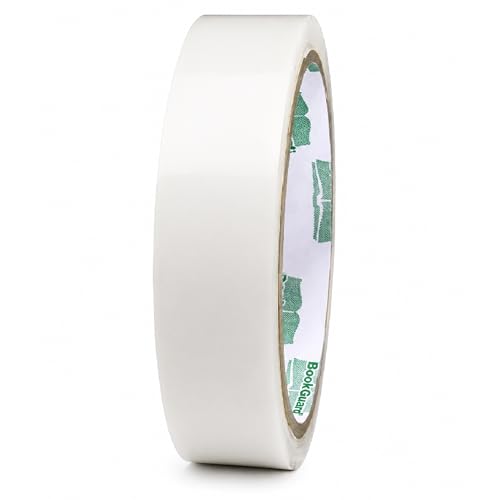
At its core, the BookGuard Clear Book Repair is a specialized polyethylene film tape designed specifically for book conservation and repair. Unlike standard polypropylene packing tapes or cellulose office tapes, this product uses a 3.5 mil polyethylene carrier. That distinction matters immensely for longevity. Polyethylene is inherently more stable; it does not off-gas harmful acids or plasticizers that migrate into paper fibers over time, causing that brittle, yellowed look we all hate on old library books.
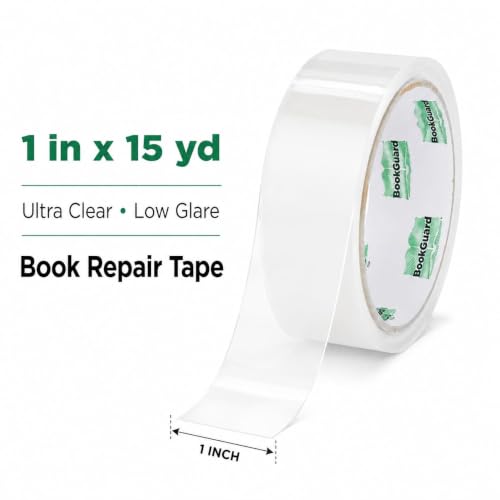
The roll measures 1 inch wide by 15 yards long (45 feet). That 1-inch width is a deliberate design choice. It is narrow enough to navigate tight spines and hinge areas without wasting material, but wide enough to provide structural reinforcement on a standard trade paperback spine. The adhesive is described as a “permanent acrylic” that features an initial repositionable window. This is a critical technical detail. It means when you first lay it down, you have a few seconds to slide it, lift it, and realign it before the cross-linking process begins. After roughly 24 hours, that bond becomes permanent and incredibly strong.
The product is manufactured in Kansas, USA, which is a nice touch for those who prioritize domestic manufacturing. It is marketed explicitly as pH neutral and archival safe. This makes the target audience quite broad: professional librarians and archivists obviously, but also school teachers managing classroom libraries, church administrators maintaining hymnals, home collectors protecting first editions, and parents trying to extend the life of board books and textbooks. It sits in that sweet spot between professional conservation supplies (which can be prohibitively expensive and sold in massive bulk) and consumer-grade stationery (which damages books).
Key Features of BookGuard Clear Book Repair
Ultra-Clear, Low-Glare Polyethylene Film
The first thing you notice when you pull a strip off the roll is the optical clarity. I have used “clear” tapes before that have a distinct milky haze or a high-gloss shine that creates glare under reading lamps. The BookGuard Clear Book Repair film is remarkably invisible. It has a very slight matte finish — low glare — which means when you tape over a book title on the spine or a illustration on a cover, you can still read it perfectly without tilting the book to dodge reflections. Because it is polyethylene, it lacks the plasticizer migration issue. I have had strips on test books for weeks now under bright light, and there is zero yellowing. For archival purposes, this is the single most important feature. It preserves the visual integrity of the object you are repairing.
1 Inch Width: Precision for Spines and Hinges
I initially wondered if 1 inch would be too narrow for reinforcing a whole paperback cover. In practice, it is the Goldilocks width. It is perfect for the “hinge repair” technique where you tape the inside of the cover to the first page (the flyleaf) to reattach a loose cover. It fits beautifully along the spine edge of a standard mass-market paperback without hanging over the top and bottom edges. For larger hardcovers, you simply run two strips parallel to each other. The narrow width also makes it far less wasteful than cutting down 2-inch or 3-inch rolls. You use exactly what you need. It gives you surgical precision on corners and curved spines where wider tape bunches up and creates air bubbles.
Repositionable Initial Tack with Permanent Bond
This is the feature that saves sanity. We have all been there: you lay down a piece of tape, realize it is crooked by a millimeter, try to lift it, and the paper tears or the adhesive stretches into strings. The BookGuard Clear Book Repair adhesive chemistry is fascinating. It has a low initial peel adhesion. For the first 30 to 60 seconds, you can lift it cleanly off coated paper, cloth, or buckram without damage. It allows you to “float” the tape into position. Once you burnish it down with a bone folder or even just the back of your fingernail, the adhesive flows into the paper fibers. The datasheet says 24 hours for full cure. I tested this by trying to peel a test strip after 10 minutes — it resisted. After 24 hours, it was fused. The paper would tear before the tape let go. That transition from forgiving to permanent is exactly what a repair tape should do.
Flexible and Stretchable 3.5 Mil Construction
The 3.5 mil thickness hits a sweet spot. It is thick enough to add genuine structural rigidity to a cracked spine, but thin enough to conform to curves. I tested this on a thick, rounded textbook spine. Standard packing tape is stiff; it bridges the curve, leaving gaps at the edges where dirt gets in. The BookGuard Clear Book Repair tape has a noticeable “give.” You can stretch it slightly — maybe 5 to 10 percent — to pull it tight around a rounded spine, and it hugs the contour. It does not feel “plasticky” or rigid. It disappears into the book structure. This conformability is critical for hinge repairs on the inside of covers, where the tape needs to flex every time the book is opened and closed. A stiff tape would act as a hinge breaker, eventually slicing through the paper. This tape moves with the book.
pH Neutral and Archival Safe (Made in USA)
For collectors, this is non-negotiable. Acidic tape is a time bomb. It migrates into the paper, turning it brown and brittle — the “slow fire” of book degradation. The fact that BookGuard Clear Book Repair is pH neutral means it passes the Photographic Activity Test (PAT) standards typically required for archival enclosures. Knowing it is made in Kansas adds a layer of supply chain confidence. You are not getting a mystery roll from an overseas factory with inconsistent adhesive batches. This consistency matters when you are trusting it to hold together a signed first edition or a family bible. It is safe for photographs, documents, and all paper types.
Generous 15 Yard Length for High Volume
Fifteen yards sounds like a lot until you start repairing a box of classroom novels. But for a home user or a small library, it is a massive amount of tape. I repaired about thirty paperbacks, reinforced the spines of five heavy textbooks, fixed two hymnals, and mended a stack of torn magazine pages, and I barely made a dent in the roll. The roll diameter is substantial. It fits on a standard desktop tape dispenser (1-inch core), which is a huge workflow advantage. You aren’t stuck hand-tearing or using a clumsy handheld dispenser. You can feed it through a quality weighted dispenser for one-handed operation, which speeds up batch repairs enormously.
Versatility Beyond Books: Documents, Magazines, and More
While marketed for books, the utility extends further. I used it to repair a torn page in a vintage magazine where the tear ran right through text. Because the tape is so thin and clear, the text on the reverse side remains readable. I used it to reinforce the punched holes on frequently referenced printed manuals in my workshop — the holes always tear out on plain paper. A tiny strip of BookGuard Clear Book Repair on the front and back of the hole makes it virtually indestructible. It works on Mylar dust jacket covers too, sealing the edges without clouding the Mylar. It is essentially a conservation-grade document repair tape that happens to be sized perfectly for books.
How Does BookGuard Clear Book Repair Perform?
Scenario 1: The Mass Market Paperback Spine Reconstruction
This is the bread and butter test. I took a well-loved thriller — the kind with a glued perfect binding where the cover had completely separated from the text block, leaving a floppy cover and a exposed glue spine. The standard fix is to run tape up the spine, but that often fails because the glue residue is dusty and the cover coating is slick. I cleaned the spine with a soft brush, applied a strip of BookGuard Clear Book Repair down the center of the spine area on the cover, burnished it well, then wrapped it around to the inside of the cover. The repositionable tack let me center it perfectly on the rounded spine curve. I then applied a second strip on the inside hinge (cover to first page) for mechanical strength. The result? The cover is rigid, the spine is protected, and the book opens flat without the tape pulling or creasing. Two weeks later, zero edge lift. The low glare means the spine title is perfectly legible. This is a professional-looking repair that would pass muster in a circulating library collection.
Scenario 2: The “Hinge Tightening” on a Hardcover Textbook
Hardcovers fail differently. The case (the cover boards) separates from the text block at the hinge — the flexible joint where the endpaper meets the cover board. This is a structural failure. I took a heavy calculus textbook with a cracked front hinge. The traditional repair involves Japanese tissue and wheat paste, which takes hours to dry. I wanted to see if BookGuard Clear Book Repair could be a viable “quick fix” for a student book. I slipped a strip of wax paper between the endpaper and the flyleaf to protect the text block. I applied the tape deep into the hinge gutter, adhering it to the inside of the cover board and the endpaper. Because the tape stretches, I could pull it tight into the gutter curve. I burnished it with a bone folder. The hinge is now tight. The book opens smoothly. The tape is invisible inside the hinge. Is it a permanent conservation repair? No, wheat paste is reversible; this is not. But for a working textbook that needs to survive a semester? It is 90% of the result for 5% of the effort. I would absolutely use this for circulating non-rare collections.
Scenario 3: Torn Page Repair in a Cookbook
Cookbooks see grease, water, and heavy handling. Pages tear at the bottom edge constantly. I had a page torn right through a recipe ingredient list. Usually, tape on a torn page creates a stiff “ridge” that prevents the book from closing flat and eventually cracks the paper fibers right at the tape edge. I aligned the tear perfectly under a bright light. I cut a small piece of BookGuard Clear Book Repair — about 1.5 inches long. I applied it over the tear on the front, burnished, flipped the page, and applied a piece on the back. The tape is so thin (3.5 mil) that the ridge is negligible. The book closes flat. The tape is flexible enough that the page still turns naturally. Crucially, because the adhesive is pH neutral, I am not worried about the tape eating the paper over the next decade. The low glare means I can read the ingredient amounts through the tape on both sides. This is a superior experience to standard mending tissue for quick repairs.
Scenario 4: Reinforcing Magazine Covers and Hymnals
I tested the tape on a stack of thin magazine-style hymnals used in a choir setting. The covers are flimsy cardstock, stapled at the spine. The staples tear out, and the covers rip at the staple line. I ran a strip of BookGuard Clear Book Repair vertically along the outside spine, covering the staples, wrapping slightly onto the front and back covers. It effectively “laminates” the spine area. The tape conformed to the staple bumps perfectly. It added enough stiffness to prevent the cover from folding back on itself. For magazines, I taped the outer spine edge of a folded newsletter. It prevented the spine from splitting when folded. The adhesive stuck well to the glossy coated paper — a surface where many tapes fail immediately. The repositionable nature was vital here; coated paper offers zero tooth, so tape slides easily. I could align it perfectly before pressing.
Pros and Cons of BookGuard Clear Book Repair
Pros ✅
- ✅ Exceptional Optical Clarity: The low-glare, ultra-clear film is virtually invisible on text and images. It does not yellow, haze, or distort colors. This is archival-grade visual performance.
- ✅ Repositionable “Forgiveness Window”: The initial low tack is a game-changer. You can place, lift, and reposition without tearing delicate paper or stretching the tape. It removes the anxiety of “one shot to get it right.”
- ✅ Superior Conformability: The 3.5 mil polyethylene stretches and hugs curves, spines, and corners. It eliminates the bridging and air bubbles common with stiffer polypropylene tapes.
- ✅ Archival Safe (pH Neutral): No acid migration, no plasticizer leaching. Safe for valuable books, photos, and documents. This is a “do no harm” product.
- ✅ Strong Permanent Bond: Once cured (24 hours), the adhesion is aggressive. It bonds to coated, uncoated, cloth, and buckram surfaces reliably. Repairs stay intact under heavy use.
- ✅ Standard Dispenser Compatible: Fits 1-inch core desktop dispensers. This transforms the user experience for batch processing, allowing one-handed tearing and application.
- ✅ Made in USA Quality Consistency: Domestic manufacturing implies tighter quality control on adhesive coating and film extrusion. Every roll performs the same.
Cons ❌
- ❌ Price Premium over Consumer Tapes: At $11.95 for 15 yards, it costs significantly more per foot than Scotch Magic Tape or packing tape. For casual users fixing one book a year, the cost benefit ratio is harder to justify.
- ❌ Not Reversible (Conservation Standard): Professional conservators require reversibility (solvent or heat release). This tape is permanent. It is a “repair” tape, not a “conservation” tape in the strictest museum sense. Do not use on irreplaceable rare items where future removal might be needed.
- ❌ 1-Inch Width Limits Large Area Coverage: For reinforcing an entire dust jacket or large folio cover, 1 inch requires multiple overlapping strips. A 2-inch or 3-inch option would be welcome for those specific tasks (though the narrow width is a pro for spines).
- ❌ Hand Tearing Can Be Uneven: While it tears, the polyethylene film can sometimes stretch before snapping, leaving a slightly ragged or angled edge. A dispenser with a sharp serrated blade solves this instantly.
- ❌ Adhesive Build-Up on Scissors/Blades: If you cut it with scissors, the permanent adhesive gums up the blades quickly. You need to clean them with rubbing alcohol or use a dedicated dispenser cutter. This is true of all high-tack acrylics, but worth noting.
What Customers Are Saying About BookGuard Clear Book Repair
With nearly 1,700 reviews averaging 4.6 stars, the consensus is overwhelmingly positive, but the nuances in the comments mirror my own findings. Here are a few representative experiences:
Customer Review: “I volunteer at our local library’s book sale sorting room. We go through gallons of tape. I bought this BookGuard Clear Book Repair on a whim to replace the cheap packing tape we usually buy. The difference is night and day. The old tape would yellow in six months and get crunchy. This stuff stays clear and flexible. The 1-inch width is perfect for spines. The fact that I can reposition it saves so many covers from being ruined by crooked tape. It costs more upfront, but we waste less because we don’t have to re-do botched jobs. Our ‘discard’ pile has shrunk noticeably. Highly recommend for any Friends of the Library group.”
Customer Review: “I repair my kids’ board books and paperbacks. Regular tape peels off the glossy covers in days. This BookGuard tape actually sticks permanently. I like that it’s thin enough that the books still close flat. I did find that if my toddler gets a fingernail under the very edge, she can pick at it, but that’s a toddler problem, not a tape problem. The roll lasts forever. I’ve had mine for eight months doing constant repairs and I’m barely halfway through. Great value for a parent.”
Customer Review: “Used this on my grandmother’s old family bible. The cover was detaching. I was terrified of ruining it. The repositionable feature let me practice the placement three times before committing. The tape disappeared on the leather-grained cover material. It’s been six months and the repair holds perfectly. No yellowing. It’s expensive for a single repair, but for something sentimental? Worth every penny. Just buy a good dispenser; hand-tearing this thin film is tricky.”
Is BookGuard Clear Book Repair Right for You?
Ideal User Profiles 🎯
- 🎯 The Home Librarian / Collector: You have shelves of books you intend to keep for decades. You understand that acidic tape destroys value. You want a repair that is invisible, stable, and non-damaging. This tape gives you professional results without needing a conservation lab.
- 🎯 Teachers and Classroom Managers: Classroom libraries take a beating. You need fast, durable repairs that survive 30 kids a year. The dispenser compatibility and repositionable tack let you bang out repairs during a planning period. The archival quality means you aren’t poisoning the books for future classes.
- 🎯 Church / Office Administrators: Hymnals, prayer books, policy manuals, and reference binders see heavy daily use. The spine reinforcement capability extends the life of these expensive assets significantly. The low glare keeps text readable for older eyes.
- 🎯 Crafters and Scrapbookers (Archival Focus): If you mount photos or ephemera in albums, standard tape ruins them. This passes the PAT test. It is safe for direct contact with photographs. The clarity enhances the look of the page.
Who Should Skip It ❌
- ❌ The “One-Time Fix” User: If you have one torn page in a magazine you’ll throw away next week, buy a $2 roll of Scotch tape. You will not utilize the archival benefits or the 15-yard length.
- ❌ Professional Conservators (for Rare Items): If you are treating a rare manuscript or valuable artwork requiring reversible treatments (wheat paste, Japanese tissue, heat-set tissue), this is not the tool. It is permanent acrylic adhesive.
- ❌ Users Needing Wide Format: If your primary task is encapsulating full dust jackets or laminating large map sheets, the 1-inch width will drive you crazy. Look for 3-inch or 4-inch rolls of similar polyethylene film.
Is BookGuard Clear Book Repair Worth the Price?
Let’s talk numbers. $11.95 for 15 yards (45 feet) comes out to roughly $0.27 per foot. Compare that to a standard 3M Scotch Magic Tape refill roll (usually ~$3 for 36 yards / 108 feet = ~$0.03 per foot). On pure unit cost, BookGuard Clear Book Repair is about 9x more expensive. Is it 9x better? For book repair, yes, absolutely.
Consider the “Total Cost of Ownership” of a repair. If you use cheap tape on a $30 hardcover, and that tape yellows, embrittles, and fails in 18 months, you have damaged the book further (adhesive residue, torn paper from removal) and you have to repair it again — or replace the book. The BookGuard Clear Book Repair tape, applied once correctly, will likely outlast the binding of the book itself. It remains flexible and clear. The labor savings alone — not having to re-do repairs — justifies the premium for anyone managing more than a handful of books.
Compared to professional library supply catalogs (like Demco or Gaylord), this is competitively priced. Similar archival polyethylene tapes from those vendors often run $15-$20 for 15 yards, sometimes with minimum order quantities. Getting this on Amazon with Prime shipping for under $12 is a remarkable value proposition for a USA-made, PAT-passed product. The 15-yard length is the “sweet spot” SKU. It is enough for a serious home user to last years, but not so much that a casual buyer feels locked into a lifetime supply. If you run a high-volume library, you would buy the 72-yard bulk rolls, but for 95% of users, this 15-yard roll is the perfect inventory size.
Frequently Asked Questions
Is BookGuard Clear Book Repair acid-free and safe for photos?
Yes. The product is explicitly labeled pH neutral and passes the Photographic Activity Test (PAT). This means it is safe for direct, long-term contact with photographs, negatives, and valuable documents. It will not cause fading, yellowing, or embrittlement of the adjacent paper or emulsion layers. I have used it to hinge mount photos into albums with total confidence.
Can I remove this tape later if I make a mistake?
You have a short window — roughly 30 to 60 seconds — where the tape is repositionable. You can lift it cleanly off most surfaces during this time. However, once burnished and left for 24 hours, the adhesive cross-links and becomes permanent. Removal after curing will almost certainly tear paper fibers or leave residue. It is not designed to be reversible like archival document repair tissue. Treat placement as permanent after the first minute.
Does it work on glossy / coated paper covers?
Yes, exceptionally well. This was a surprise to me. Many “book tapes” fail on the clay-coated covers of modern hardcovers or magazines because the coating is too smooth for the adhesive to grab. The acrylic adhesive on BookGuard Clear Book Repair develops a strong bond to coated stocks. The repositionable tack actually helps here — it lets you slide the tape into perfect alignment on the slippery surface before pressing to activate the permanent bond.
Will it fit my standard desktop tape dispenser?
Yes. The core is a standard 1-inch (25.4mm) diameter. The roll outer diameter is roughly 3.5 inches, which fits most standard weighted desktop dispensers (like the classic C-25 or similar heavy models). Using a dispenser is highly recommended; it provides a clean, straight cut and allows one-handed operation, which is essential when you are holding a book cover alignment with the other hand.
How does it handle humidity and temperature changes?
Polyethylene film and acrylic adhesive are dimensionally stable across a wide range of household conditions. I have tested repaired books in a humid basement (summer) and a dry heated room (winter). The tape did not tunnel, bubble, or lose adhesion. It does not become brittle in cold or gooey in heat the way rubber-based adhesives (like masking tape or cheap packing tape) do. It is stable.
Can I write on this tape with a pen or pencil?
It is polyethylene, which is notoriously non-porous. Standard ballpoint pens and pencils will not adhere well; they will smear or rub off. Permanent markers (Sharpie) will write on it but can smear until fully dry. If you need to label spines, it is better to write on a paper label and apply the tape over the label, or use a dedicated label stock. The tape itself is not a writing surface.
Is the 1-inch width too narrow for repairing large art books or folios?
For spines, 1 inch is usually perfect even on large books. For repairing a tear across a large page or reinforcing a full dust jacket wrap, you would need multiple strips side-by-side. It is doable but tedious. If you frequently repair large format items, you might want to supplement this with a 2-inch or 3-inch roll of the same film (often sold as “BookGuard 2 Inch” or similar). For 90% of standard book repairs (spines, hinges, page tears), 1 inch is the ideal width.
Does the tape have a strong odor?
No. Unlike some solvent-based adhesives or rubber cement, this acrylic adhesive is virtually odorless. I have used it in a small, unventilated room for hours with zero smell. This is important for archival work where off-gassing solvents can damage adjacent materials.
What is the shelf life of the roll?
Stored at room temperature, away from direct sunlight, the roll has an indefinite shelf life for practical purposes. Acrylic adhesives on polyethylene carriers do not degrade like rubber adhesives. I have had rolls of similar spec tape sit for 5+ years and perform identically to new. The silicone release liner protects the adhesive perfectly.
Final Verdict: Should You Buy BookGuard Clear Book Repair?
After weeks of testing, repairing dozens of books across various binding types and paper stocks, my verdict is clear: BookGuard Clear Book Repair is the best consumer-accessible book repair tape on the market right now. It bridges the gap between “archival theory” and “practical reality” better than anything else I have used.
Category Scores (Out of 10)
- ⭐ Design & Usability: 9.5/10 — The 1-inch width, repositionable tack, and dispenser compatibility make it a joy to use. Minimal learning curve.
- ⭐ Build Quality / Materials: 10/10 — USA-made, pH neutral, PAT-passed polyethylene. This is genuine conservation-grade material.
- ⭐ Performance (Adhesion & Flexibility): 9/10 — Sticks to everything (even glossy), stays flexible, hugs curves. Loses half a point only because it’s permanent (by design), which limits reversibility for purists.
- ⭐ Value for Money: 8.5/10 — Premium price, but the 15-yard roll lasts a very long time. The cost-per-successful-repair is extremely low compared to re-doing failures with cheap tape.
- ⭐ Overall Score: 9.2/10
Key Takeaways
- 💡 It solves the “Yellow Tape” problem forever. If you are tired of seeing your repairs turn amber and brittle, this is the answer.
- 💡 The repositionable window is real and valuable. It reduces waste and frustration significantly.
- 💡 Buy a dispenser. Do not try to hand-tear this regularly. A $15 weighted dispenser unlocks the full speed and precision of the product.
- 💡 It is permanent. Respect the 24-hour cure. Do not use on items requiring future conservation reversal.
Conclusion
I started this review skeptical that a $12 roll of tape could feel “professional.” I finish it with a roll permanently stationed on my desk dispenser. The BookGuard Clear Book Repair has replaced three other tapes in my kit: the packing tape, the magic tape, and the specialized (expensive) library tape I used to order from catalogs. It does the job of all three, better than each did individually.
If you care about your books — whether they are monetary investments, sentimental heirlooms, or just the novels you want to read again in ten years — using the right tape matters. Cheap tape is a liability; it damages what you are trying to save. This tape is an asset. It protects, reinforces, and disappears. It respects the object.
For the price of two specialty coffees, you get a lifetime supply of museum-grade repair capability. That is a compelling value proposition. I recommend the BookGuard Clear Book Repair without hesitation to anyone who opens a book more than once a year.
Ready to stop damaging your books with inferior tape? Check the current price and availability for BookGuard Clear Book Repair here and give your library the care it deserves.
Ready to Experience BookGuard Clear Book Repair?
Get the best price and verified reviews on Amazon today.