Featured image for this comprehensive guide about CBT exercises
Image source: waota.com.au
Feeling overwhelmed by persistent worries, sadness, or a general sense of unease? You’re not alone. In our fast-paced world, anxiety and depression affect millions, often making daily life a struggle. The good news is that powerful tools exist to help you navigate these challenging emotions and regain control over your mental well-being. One of the most effective and evidence-based approaches is Cognitive Behavioral Therapy (CBT).
CBT is a widely recognized form of psychotherapy that focuses on understanding the interconnectedness of our thoughts, feelings, and behaviors. It empowers individuals to identify and challenge unhelpful thinking patterns and adopt more constructive ways of responding to life’s stressors. Instead of just masking symptoms, CBT equips you with practical, actionable skills that lead to lasting change. It’s not about ignoring difficulties; it’s about learning how to approach them differently.
This comprehensive guide will delve into the world of CBT exercises, providing you with a toolkit of practical strategies you can use to manage anxiety, combat depression, and foster greater emotional resilience. Whether you’re new to CBT or looking to deepen your existing practice, these exercises are designed to be integrated into your daily life, offering immediate relief and long-term benefits. Let’s explore how you can harness the power of your mind to transform your emotional landscape.
Quick Answers to Common Questions
What exactly *are* CBT exercises?
CBT exercises are practical techniques from Cognitive Behavioral Therapy that help you identify and change unhelpful thinking patterns and behaviors. Think of them as mental workouts for your brain to build healthier coping skills!
How do these CBT exercises actually help with anxiety or depression?
They help you challenge negative thoughts, develop more balanced perspectives, and practice new behaviors that reduce symptoms. By changing how you think and act, you can significantly improve your mood and reduce stress.
Are CBT exercises difficult to start?
Not at all! Many CBT exercises are simple, step-by-step practices you can integrate into your daily routine. Like any new skill, they get easier and more effective with consistent practice.
Can I do CBT exercises on my own, or do I need a therapist?
Absolutely! While a therapist can guide you, many CBT exercises are designed for self-help and can be practiced independently using resources like this blog post. Getting started is often the biggest step.
How fast can I see results from CBT exercises?
You might notice small shifts in your thinking or mood almost immediately, but consistent practice of CBT exercises usually brings more significant, lasting changes over a few weeks. Every bit of effort adds up!
📋 Table of Contents
- Understanding the Core of CBT: Thoughts, Feelings, and Behaviors
- Cognitive Restructuring: Challenging Unhelpful Thoughts
- Behavioral Activation: Taking Action to Improve Mood
- Mindfulness and Relaxation: Grounding Your Mind and Body
- Problem-Solving Skills: Practical Approaches to Life’s Challenges
- Sustaining Progress: Integrating CBT into Daily Life & Finding Support
- Conclusion: Your Path to Mental Well-being
Understanding the Core of CBT: Thoughts, Feelings, and Behaviors
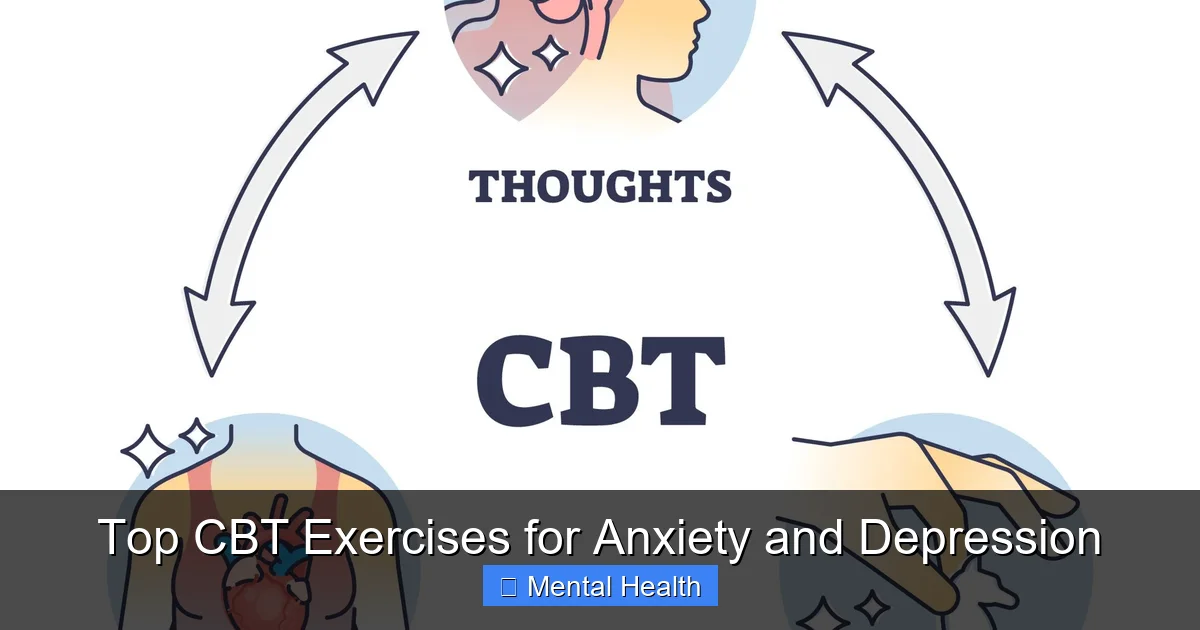
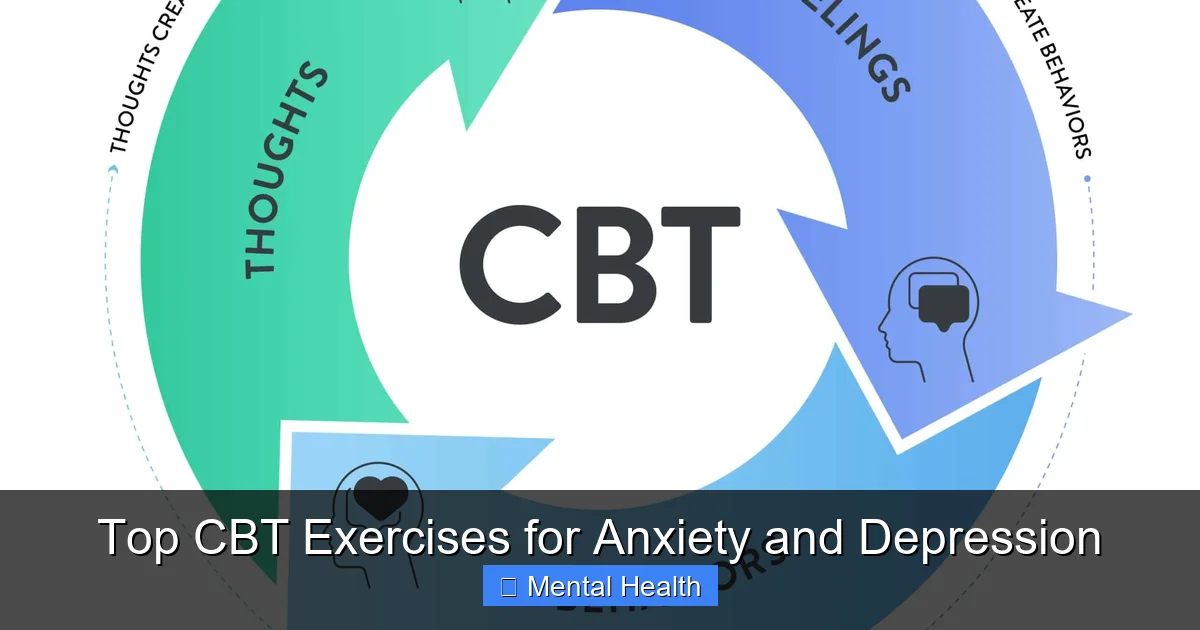
At the heart of Cognitive Behavioral Therapy lies a fundamental principle: our thoughts, feelings, and behaviors are inextricably linked. This means that a change in one area can profoundly impact the others. For example, if you think, “I’m going to fail this presentation” (thought), you might feel anxious (feeling), and then avoid preparing adequately (behavior), which increases the likelihood of a less-than-stellar outcome, reinforcing the initial negative thought.
Learn more about CBT exercises – Top CBT Exercises for Anxiety and Depression
Image source: mindhealth.com.au
CBT doesn’t suggest that your thoughts cause your feelings directly, but rather that your interpretation of events, influenced by your thoughts, shapes your emotional response. It also emphasizes that many of our reactions are learned patterns that can be unlearned and replaced with healthier ones. The goal isn’t to think “positive thoughts” all the time, but rather to develop more balanced, realistic, and helpful thought patterns that lead to more adaptive behaviors and improved emotional states.
| CBT Exercise | Primary Goal/Mechanism | Typical Practice | Common Benefit/Outcome |
|---|---|---|---|
| Thought Record / Cognitive Restructuring | Identify and challenge automatic negative thoughts; replace with balanced perspectives. | 15-20 minutes daily, 3-5 times/week (initial weeks). | Reduced emotional distress, improved cognitive flexibility, greater self-awareness. |
| Behavioral Activation | Increase engagement in meaningful and enjoyable activities to counteract withdrawal/passivity. | Schedule 1-3 activities daily; track mood pre/post activity. | Improved mood, increased energy levels, significant reduction in depressive symptoms. |
| Graded Exposure Therapy | Gradually confront feared situations/objects to reduce anxiety and avoidance behaviors. | 30-60 minute sessions, 1-3 times/week, until anxiety significantly reduces. | Decreased fear and anxiety responses, increased confidence in feared situations, habituation. |
| Mindfulness & Deep Breathing | Ground oneself in the present moment, regulate physiological stress responses. | 5-10 minutes daily, or as needed during acute stress/anxiety. | Reduced stress and anxiety, enhanced emotional regulation, improved focus. |
| Problem-Solving Skills Training | Develop structured approaches to address life challenges, reducing feelings of overwhelm. | 20-30 minutes per problem, as needed, or weekly structured practice. | Increased sense of control, effective coping strategies, reduced stress from daily stressors. |
The beauty of CBT lies in its practical, hands-on approach. It’s less about deep-diving into past traumas (though sometimes relevant) and more about equipping you with skills to address present-day challenges. Through various CBT exercises, you learn to become your own therapist, developing the awareness and tools needed to navigate the complexities of your inner world. This empowers you to break free from cycles of negative thinking and behavior, fostering a sense of control and agency over your mental health journey.
Cognitive Restructuring: Challenging Unhelpful Thoughts
One of the cornerstones of CBT is cognitive restructuring, a process of identifying, challenging, and changing unhelpful or irrational thought patterns. Our minds often generate “automatic negative thoughts” (ANTs) that can feel very real, even when they’re not entirely accurate. Learning to scrutinize these thoughts is a crucial step towards reducing anxiety and depression. These CBT exercises help you become a detective of your own mind.
Learn more about CBT exercises – Top CBT Exercises for Anxiety and Depression
Image source: yourmindmatters.net.au
The Thought Record/Thought Journal
This is perhaps one of the most powerful CBT exercises. A thought record helps you systematically analyze your negative thoughts and develop alternative, more balanced perspectives.
How to do it:
- Situation: Briefly describe the event or situation that triggered your negative feelings.
- Moods: Identify the emotions you felt (e.g., anxious, sad, angry) and rate their intensity (0-100%).
- Automatic Thoughts: Write down all the negative thoughts that went through your mind. These are often brief, automatic, and unexamined.
- Evidence For: List all the factual evidence that supports your automatic thought.
- Evidence Against: List all the factual evidence that contradicts your automatic thought. Consider alternative explanations, other perspectives, or past experiences.
- Alternative/Balanced Thought: Based on the evidence, formulate a more realistic, balanced, and helpful thought.
- Outcome: Re-rate your moods (0-100%) and describe how your feelings and behavior might change with the new thought.
Practicing this regularly helps you spot thinking errors like catastrophizing, mind-reading, or all-or-nothing thinking.
Socratic Questioning
Named after the Greek philosopher Socrates, this technique involves asking yourself a series of questions to challenge your assumptions and beliefs. It’s about inquiry, not judgment.
Example Questions to Ask Your Negative Thoughts:
- What is the evidence for this thought? What is the evidence against it?
- Am I looking at all the evidence, or just what supports my negative thought?
- Is there another way of looking at this situation?
- What would I tell a friend who had this thought?
- Am I mistaking a thought for a fact?
- What’s the worst that could happen? How would I cope?
- What’s the best that could happen?
- What’s the most realistic outcome?
- Is this thought helpful? Does it help me achieve my goals?
These questions help you gain perspective and detach from unhelpful thought patterns, making it a powerful collection of CBT exercises.
Behavioral Activation: Taking Action to Improve Mood
While challenging thoughts is vital, CBT also recognizes the powerful link between our actions and our mood. When depressed, people often withdraw from activities they once enjoyed, leading to a vicious cycle of decreased pleasure and increased sadness. Similarly, anxiety can lead to avoidance behaviors that restrict life and reinforce fear. Behavioral activation is a set of CBT exercises designed to break these cycles by encouraging engagement in meaningful and enjoyable activities, regardless of initial motivation.
Activity Scheduling
This simple yet profound exercise involves deliberately planning and engaging in activities that bring pleasure or a sense of accomplishment.
How to do it:
- Identify Values & Goals: Think about what’s important to you (e.g., creativity, connection, health) and set small, achievable goals related to these values.
- Brainstorm Activities: List activities you used to enjoy, activities you’d like to try, or necessary tasks that give a sense of accomplishment (e.g., reading, walking, calling a friend, organizing a drawer).
- Schedule It: Look at your week and intentionally schedule specific times for these activities, treating them as important appointments.
- Track & Reflect: After completing an activity, note your mood before and after, and reflect on what you learned. Did you feel better than you expected?
Even small actions can generate positive feelings, gradually increasing motivation and reducing feelings of helplessness. This is one of the most effective CBT exercises for depression.
Graded Exposure
For anxiety and phobias, avoidance is a primary maintainer of fear. Graded exposure is a systematic approach to gradually confronting feared situations or objects, allowing you to learn that your fears are often exaggerated and manageable.
How to do it:
- Create a Fear Hierarchy: List all situations related to your fear, from least anxiety-provoking to most. Rate each item on a subjective distress scale (e.g., 0-100).
- Start Small: Begin with the least feared item on your list. Expose yourself to it until your anxiety naturally decreases (habituation).
- Practice & Progress: Once you’re comfortable with one step, move to the next. The goal is to stay in the situation long enough for your anxiety to subside.
- Repeat: Consistent practice helps rewire your brain’s fear response.
This is a powerful set of CBT exercises that should ideally be done with the guidance of a therapist, especially for severe phobias or PTSD.
Mindfulness and Relaxation: Grounding Your Mind and Body
While not traditionally core to classical CBT, mindfulness and relaxation techniques have been effectively integrated into modern CBT to enhance emotional regulation and stress reduction. These CBT exercises help you stay grounded in the present moment, observe thoughts without judgment, and calm your physiological stress response.
Mindful Breathing
This simple exercise brings your attention to the sensations of your breath, anchoring you in the present moment and disengaging from spiraling thoughts.
How to do it:
- Find a quiet place to sit comfortably.
- Close your eyes gently or soften your gaze.
- Bring your attention to your breath. Notice the sensation of air entering and leaving your body – perhaps in your nostrils, chest, or abdomen.
- Don’t try to change your breath; just observe it.
- When your mind wanders (which it will), gently guide your attention back to your breath without judgment.
- Start with 2-3 minutes and gradually increase the duration.
Regular practice of this fundamental mindfulness technique can significantly reduce stress and improve focus.
Progressive Muscle Relaxation (PMR)
PMR involves systematically tensing and then relaxing different muscle groups in the body. This helps you become aware of the difference between tension and relaxation, and to release physical stress.
How to do it:
- Find a comfortable position, either sitting or lying down.
- Starting with your feet, tense the muscles as tightly as you can for 5-10 seconds.
- Then, completely release the tension, letting your muscles go limp and noticing the contrast.
- Move up your body, group by group: calves, thighs, glutes, abdomen, chest, arms, hands, shoulders, neck, face.
- Pay attention to the sensations of relaxation that spread through your body.
PMR is an excellent relaxation technique among the arsenal of CBT exercises, particularly effective for physical symptoms of anxiety.
Problem-Solving Skills: Practical Approaches to Life’s Challenges
CBT isn’t just about managing internal states; it also equips you with practical skills to address external stressors and life challenges. Many people feel overwhelmed by problems, leading to feelings of helplessness or anxiety. These problem-solving CBT exercises provide a structured approach to tackling difficulties head-on, fostering a sense of competence and control.
Structured Problem Solving
This systematic approach helps you break down problems into manageable steps, making solutions seem more achievable.
How to do it:
- Define the Problem: Clearly and specifically state what the problem is. Avoid vague language.
- Brainstorm Solutions: Generate as many potential solutions as you can, no matter how wild or impractical they may seem at first. Don’t evaluate them yet.
- Evaluate Solutions: For each solution, list pros and cons. Consider the potential impact, feasibility, and resources required.
- Choose the Best Solution: Select the solution that seems most promising and actionable.
- Develop an Action Plan: Outline specific steps you’ll take to implement the chosen solution. Who will do what, when, and how?
- Implement and Review: Put your plan into action and then review its effectiveness. If it didn’t work, go back to step 2 or 3 and try another solution.
This practical approach turns daunting problems into manageable tasks, reducing anxiety and increasing self-efficacy.
Assertiveness Training
Difficulty asserting oneself can lead to resentment, stress, and unfulfilled needs. Assertiveness training teaches you how to communicate your thoughts, feelings, and needs directly and respectfully, without being aggressive or passive.
Key Principles:
- “I” Statements: Express your feelings and needs using “I feel X when Y happens because Z.”
- Clear, Concise Requests: State what you want or need specifically.
- Respect for Others: Acknowledge and respect the other person’s rights and feelings, even if you disagree.
- Body Language: Maintain eye contact, use a calm tone of voice, and have open posture.
- Practice: Start with lower-stakes situations and gradually work up to more challenging ones. Role-playing can be very helpful.
Learning to be assertive is a vital life skill and one of the important CBT exercises for improving relationships and reducing interpersonal stress.
Sustaining Progress: Integrating CBT into Daily Life & Finding Support
Learning CBT exercises is an ongoing journey, not a one-time fix. The real power of CBT comes from consistent practice and integrating these skills into your daily life. Just like physical exercise, mental exercises require dedication to build strength and resilience. Sustaining progress means developing a long-term strategy for maintaining your mental well-being.
Building a Relapse Prevention Plan
It’s natural to experience setbacks or difficult periods. A relapse prevention plan helps you anticipate challenges and prepare for them, rather than being caught off guard.
Elements of a Relapse Prevention Plan:
- Identify Warning Signs: What are the early indicators that your anxiety or depression might be returning (e.g., changes in sleep, increased irritability, social withdrawal, specific negative thoughts)?
- Coping Strategies: List the specific CBT exercises and other coping mechanisms that have worked for you in the past.
- Support System: Identify trusted friends, family members, or professionals you can reach out to when you need support.
- Lifestyle Factors: Reinforce healthy habits like regular sleep, balanced diet, exercise, and stress reduction.
- Review and Adjust: Periodically review your plan and adjust it as your needs and circumstances change.
This proactive approach helps you maintain the gains you’ve made and prevents minor dips from becoming major relapses.
When to Seek Professional Guidance
While self-help CBT exercises can be incredibly effective, there are times when professional guidance is essential. A qualified CBT therapist can provide personalized support, help you tailor exercises to your specific needs, and address more complex mental health challenges.
Consider professional help if:
- Your symptoms are severe or persistent and significantly impair your daily functioning.
- You’ve tried self-help methods but haven’t seen significant improvement.
- You’re struggling with suicidal thoughts or severe self-harm urges (seek immediate help).
- You have co-occurring mental health conditions or complex trauma.
- You feel overwhelmed or unsure how to apply the exercises effectively.
A good therapist acts as a guide, helping you learn and implement these powerful strategies more effectively. In fact, research shows that CBT is one of the most effective treatments for various conditions.
Effectiveness of CBT for Common Mental Health Conditions:
CBT is an empirically supported treatment with a strong evidence base. Here are some general statistics regarding its efficacy:
| Condition | Typical Efficacy/Improvement Rate* | Key Benefit |
|---|---|---|
| Anxiety Disorders (GAD, Panic Disorder, Social Anxiety, Phobias) | 60-75% significant symptom reduction | Teaches coping skills, reduces avoidance, challenges catastrophic thinking. |
| Depression (Major Depressive Disorder) | 50-70% achieve remission or significant improvement | Increases engagement in rewarding activities, challenges negative thought patterns. |
| Obsessive-Compulsive Disorder (OCD) | 50-70% reduction in symptoms with Exposure and Response Prevention (a CBT variant) | Helps confront fears without engaging in compulsions. |
| Post-Traumatic Stress Disorder (PTSD) | 40-60% show symptom improvement with trauma-focused CBT | Processes traumatic memories, reduces avoidance and hyperarousal. |
*These are general ranges and individual results may vary. Efficacy often depends on severity of symptoms, client engagement, and therapist expertise. Sources include various meta-analyses and clinical trials on CBT.
Conclusion: Your Path to Mental Well-being
The journey to improved mental well-being is a deeply personal one, and equipped with the right tools, you have the power to navigate its complexities. Cognitive Behavioral Therapy offers a robust framework and a collection of practical CBT exercises that empower you to become an active participant in your healing process. By understanding the intricate dance between your thoughts, feelings, and behaviors, you can learn to challenge unhelpful patterns, engage in life-affirming actions, and cultivate greater emotional resilience.
Remember, these CBT exercises are not magic bullets, but rather skills that require practice, patience, and persistence. Start small, be kind to yourself, and celebrate every step forward. Whether you’re using thought records to challenge negative beliefs, scheduling pleasant activities to boost your mood, or practicing mindfulness to stay grounded, each effort contributes to building a stronger, healthier mind. Embrace the power of these proven techniques, and embark on a path towards a more balanced, fulfilling, and emotionally resilient life.
Frequently Asked Questions
What exactly are CBT exercises and how do they work?
CBT exercises are practical techniques derived from Cognitive Behavioral Therapy, designed to help individuals identify and change unhelpful thought patterns and behaviors. They work by teaching you to recognize cognitive distortions and replace them with more balanced perspectives, alongside encouraging positive behavioral changes.
How effective are CBT exercises for managing anxiety and depression?
CBT exercises are highly effective and evidence-based strategies for significantly reducing symptoms of anxiety and depression. Consistent practice can lead to a noticeable improvement in mood, coping skills, and overall mental well-being by addressing the root causes of distress.
Can I practice CBT exercises on my own, or do I need a therapist?
Many simple CBT exercises can be practiced effectively on your own using resources like guided apps, books, or online articles. However, working with a qualified CBT therapist is highly recommended for personalized guidance, deeper insights, and to address more complex or severe symptoms of anxiety and depression.
How long does it typically take to see results from consistent CBT exercises?
The time it takes to see results from CBT exercises can vary for everyone, but many individuals report noticing improvements within a few weeks to a couple of months of consistent practice. Regular engagement and dedication to the exercises are key to achieving lasting change and symptom reduction.
What are some simple CBT exercises I can start with today for anxiety or depression?
You can begin with exercises like thought challenging, where you question negative thoughts, or gratitude journaling to shift focus to positive aspects. Behavioral activation, which involves scheduling enjoyable activities, is also a great starting point for combating depression and increasing engagement.
Are there any potential downsides or challenges when doing CBT exercises?
While generally safe, some people might initially find CBT exercises challenging as they require introspection and confronting uncomfortable thoughts or feelings. It demands effort and consistency, but any initial discomfort is typically a temporary part of the process leading to long-term benefits.