
There’s nothing quite like the luxurious warmth of radiant floor heating spreading throughout your home. It’s an incredibly comfortable and efficient way to heat, but to truly maximize its benefits – both in terms of cozy comfort and energy savings – you need the right control system. That’s where a programmable thermostat for radiant floor heat comes in.
Unlike conventional forced-air systems, radiant floor heating requires a specialized thermostat designed to handle the unique characteristics of heating a floor. These devices often include floor sensors to prevent overheating and maintain consistent warmth, along with essential safety features like Ground Fault Circuit Interrupters (GFCIs). Choosing the best one can seem daunting, but don’t worry, we’ve done the legwork for you!
We’ve rounded up five top-notch programmable thermostats that are specifically built for radiant floor heating systems. These options offer excellent temperature control, energy-saving features, and robust safety protocols to keep your toes toasty and your energy bills in check. Let’s dive into our picks!
1. Programmable Thermostat for House Radiant Underfloor Heating (with GFCI)
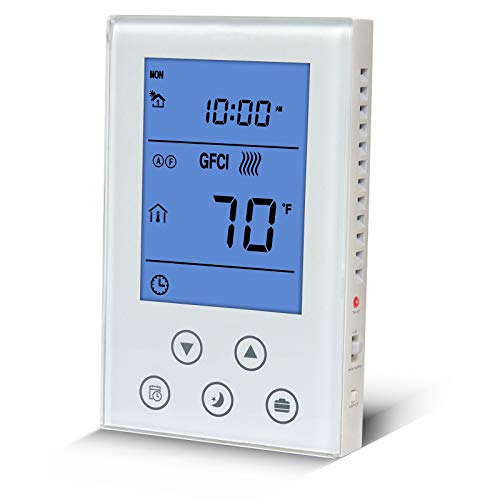
This thermostat stands out for its robust safety features and versatile compatibility, making it a reliable choice for any electric underfloor heating setup. It’s engineered with a built-in Class A GFCI, providing crucial protection against electrical shocks and ensuring your radiant heating system operates safely. Beyond safety, its ability to work with both 120VAC and 240VAC systems, coupled with a 7-day programming schedule, makes it a highly adaptable and energy-efficient solution for maintaining your desired home climate.
Key Features:
– Works with 120VAC / 240VAC (50/60Hz), max 15A
– cETL Listed with built-in Class A GFCI for safety
– Includes both floor and air sensors
– Large LCD digital display with backlight for easy reading
– 7-day programmable line volt thermostat for optimized comfort and cost reduction
– ON/STANDBY switch for seasonal shutdown
– Universal compatibility with existing radiant floor heating systems
– 5-year limited warranty
Pros:
– Exceptional safety features with cETL listed, self-testing Class A GFCI
– Dual voltage compatibility (120V/240V) offers broad application
– Offers both floor and ambient air temperature sensing
– Clear, easy-to-read LCD display
– Good warranty period provides peace of mind
Cons:
– GFCI sensitivity can be high, potentially tripping if wiring isn’t perfectly isolated
– Product name is a bit generic, making it harder to remember
– Lacks smart home integration or Wi-Fi features
User Impressions:
Users frequently highlight the peace of mind that comes with the integrated GFCI, noting its importance for electric floor heating. They also appreciate the straightforward 7-day programming, which helps them dial in their comfort without overspending on electricity. While some found the GFCI test process a bit particular, overall, it’s seen as a solid, safe, and effective thermostat.
2. Honeywell TH115-AF-GA/U Radiant Heating 120/240V Thermostat

Honeywell is a name synonymous with reliability in home climate control, and their TH115-AF-GA/U brings that trusted performance to radiant floor heating. This programmable thermostat for radiant floor heat offers a straightforward, no-nonsense approach to temperature management, focusing on core functionality with the backing of a major brand. Its key differentiator is the flexibility to choose from three distinct temperature control options – ambient, floor, or ambient with floor temperature limits – giving you precise control over your underfloor heating experience.
Key Features:
– Brand: Honeywell
– 7-day programmable line volt thermostat
– Compatible with 120V/240V radiant heating systems
– Three temperature control choices: Ambient, Floor, or Ambient with Floor temperature limits
– Specifically designed for radiant floor applications
Pros:
– Trusted brand reputation for quality and reliability
– Flexible control modes cater to different heating preferences
– Simple and effective 7-day programming
– Dual voltage compatibility for wider use
Cons:
– Lacks advanced features like touchscreen, Wi-Fi connectivity, or detailed energy logging
– More basic display compared to modern digital screens
– May not include a built-in GFCI, requiring an external one
User Impressions:
Customers often praise this Honeywell thermostat for its dependable performance and ease of basic programming. Many appreciate the brand’s long-standing reputation, stating that it “just works.” While it might not boast all the bells and whistles of some competitors, its consistent functionality and multiple control options make it a solid choice for those who value simplicity and reliability.
3. OJ Microline UDG4 Touchscreen Programmable Floor Thermostat

The OJ Microline UDG4 takes modern floor heating control to the next level with its intuitive touchscreen interface and intelligent features. This isn’t just a thermostat; it’s a sophisticated command center for your warmth. Its “Adaptive function” is a game-changer, allowing the unit to self-learn and adjust its run time to optimize temperatures while actively working to reduce energy consumption. If you’re looking for sleek design combined with smart energy management, the UDG4 is definitely one to consider.
Key Features:
– Intuitive touchscreen interface with 3.5″ responsive color screen
– Class A GFCI (Ground Fault Circuit Interrupter) built-in
– Dual voltage (120V/240V) and Dual Sensing (Air/Floor)
– 7-day programmable with new Install Wizard and Adaptive function
– Suitable for various floor types (Tile, Marble, Carpet, Concrete Laminate, Wood)
– Additional features: Child Lock, Vacation Mode, OPEN Window Mode, power logging
– C-UL-us Listed and certified for wet room installations
– 3-Year limited factory warranty
Pros:
– Modern and user-friendly touchscreen display
– “Adaptive function” offers intelligent energy savings
– Power logging provides detailed energy usage reports
– Comprehensive safety features with Class A GFCI
– Attractive design blends seamlessly into decor
Cons:
– Higher price point due to advanced features
– May have a slight learning curve for maximizing all advanced settings
– No direct Wi-Fi/smart home integration mentioned (though power logging can export data)
User Impressions:
Reviewers rave about the UDG4’s beautiful color touchscreen and how easy it is to navigate compared to traditional button-based thermostats. The adaptive learning feature often gets special mention for making their homes consistently comfortable without constant manual adjustments, leading to noticeable energy savings. The sleek aesthetics are also a big win for many users.
4. OJ Microline Touchscreen Programmable Radiant Floor Heating Thermostat
Another excellent offering from OJ Microline, this touchscreen programmable thermostat for radiant floor heat is designed with universal compatibility and energy monitoring at its core. While sharing many similarities with the UDG4, this model emphasizes its ease of use through a simple, responsive touchscreen and robust energy usage reporting. It’s built to seamlessly integrate with any existing radiant floor heating system, making it an ideal upgrade for those who want both modern convenience and enhanced energy awareness without a complex setup.
Key Features:
– Easy-to-use touchscreen interface with 3.5″ responsive color screen
– Air and Floor sensing capabilities
– 7-day program scheduling for maximum comfort and cost reduction
– In-built power logging for detailed energy usage reports
– Child Lock feature for safety
– Universal compatibility with existing radiant floor heating systems
– Dual voltage (120V/240V), UL listed, with self-testing Class A GFCI
– 3-year limited warranty
– Specific floor protection limits for laminate/wood and tile floors
Pros:
– User-friendly touchscreen for intuitive control
– Excellent energy monitoring features with power logging
– Strong safety standards (UL listed, self-testing Class A GFCI)
– Universal compatibility for easy integration
– Sleek design enhances home aesthetics
Cons:
– Programming can still require some initial setup time
– Similar feature set to UDG4, potentially confusing to differentiate without deep dive
– Lacks Wi-Fi for remote control (based on provided info)
User Impressions:
Customers love the responsiveness of the touch screen and the clear energy usage reports, which help them understand and optimize their heating habits. The self-testing GFCI is also a popular feature for its added safety assurance. Many found the installation straightforward and were pleased with its ability to consistently maintain comfortable floor temperatures.
5. OJ Microline UTN4 Radiant Floor Heat Thermostat w/Class A GFCI

If you’re someone who values simplicity and straightforward operation above complex scheduling, the OJ Microline UTN4 is your ideal match. This digital non-programmable thermostat for underfloor heating is designed as a “Plug & Play” solution. You simply set your desired temperature, and it does the rest. It doesn’t skimp on essential features though, including a built-in Class A GFCI, dual voltage capability, and versatile dual sensors, offering three different control modes to perfectly suit your specific radiant heating needs without the hassle of programming.
Key Features:
– Electric radiant floor heating thermostat for various floor types
– Built-in Class A GFCI, c UL us Listed for USA and Canada
– Easy-to-use, non-programmable “Plug & Play” design
– Dual voltage (120v, 208v, 240v) for broad system compatibility
– Dual sensor (10Kohm Floor sensor and built-in Air sensor)
– Three different control modes: (A) Ambient with Floor protection, (B) Floor temperature with floor protection, (C) Ambient without Floor protection
– Load: 15A-1800w@120v, 3600w@240v
– Manufacturer’s limited 3-year warranty
Pros:
– Extremely simple “set it and forget it” operation (non-programmable)
– Excellent safety with built-in Class A GFCI (c UL us Listed)
– Highly versatile dual voltage and dual sensor capabilities
– Multiple control modes offer tailored heating
– Ideal for users who prefer minimal setup and fuss
Cons:
– Lack of programming means less potential for optimized energy savings through scheduling
– Basic digital display compared to touchscreen models
– Not suitable for those who need complex daily schedules
User Impressions:
Users who chose the UTN4 absolutely love its straightforward nature. They report that it’s incredibly easy to install and operate, making it perfect for guest rooms, bathrooms, or anyone who just wants instant warmth without needing to navigate complex menus. Its reliability and robust safety features are also frequently praised.
Frequently Asked Questions about Programmable Thermostats for Radiant Floor Heat
Q1: What is a programmable thermostat for radiant floor heat, and why do I need one?
A: A programmable thermostat for radiant floor heat is a specialized device designed to control electric or hydronic underfloor heating systems. Unlike standard thermostats, these often include a floor sensor to measure the actual floor temperature, preventing overheating and ensuring consistent, comfortable warmth. You need one to maximize energy efficiency, prevent damage to certain floor coverings (like wood or laminate), and provide precise temperature control specific to your radiant system.
Q2: Can I use a regular thermostat for my radiant floor heating system?
A: No, it’s highly recommended against using a regular thermostat for radiant floor heat. Conventional thermostats are designed for forced-air systems and only measure ambient air temperature. Radiant floor systems require a thermostat that can read floor temperature, often via a floor sensor, to prevent damage to flooring materials and ensure safe, efficient operation. Using the wrong thermostat can lead to an overheated floor, discomfort, energy waste, or even damage.
Q3: What is GFCI, and why is it important for radiant floor heating thermostats?
A: GFCI stands for Ground Fault Circuit Interrupter. It’s a vital safety feature that quickly shuts off electric power if it detects a ground fault – an unintentional path for electricity to flow to the ground, which can cause electric shock. For electric radiant floor heating systems, a built-in Class A GFCI is often required by electrical codes and is crucial for protecting occupants from potential electrocution, especially in areas like bathrooms or kitchens where water is present.
Q4: What’s the difference between ambient and floor sensing modes on a thermostat?
A:
* Ambient Sensing: The thermostat measures the air temperature in the room, similar to a traditional thermostat. It will activate the heating to bring the room air to your set point.
* Floor Sensing: The thermostat measures the temperature directly at the floor surface using an external sensor. This mode is ideal for maintaining a consistent floor temperature and preventing damage to delicate floor coverings.
* Ambient with Floor Limit: This hybrid mode heats based on ambient air temperature but also has a floor sensor to ensure the floor doesn’t exceed a safe maximum temperature, offering both comfort and protection.
Q5: How do programmable thermostats save energy with radiant floor heating?
A: Programmable thermostats save energy by allowing you to set specific heating schedules for different times of the day or week. For instance, you can program the heat to lower when you’re away at work or asleep and then warm up just before you arrive home or wake up. This avoids continuously heating an empty house or an unnecessarily warm floor, significantly reducing energy consumption and heating costs. Features like “adaptive learning” or “open window mode” further enhance these savings.
Q6: Are Wi-Fi enabled radiant floor thermostats worth the investment?
A: Wi-Fi enabled thermostats for radiant floor heat offer convenience and often enhanced energy-saving capabilities. They allow you to control your heating system remotely via a smartphone app, adjust schedules, and monitor energy usage from anywhere. While they typically come at a higher price point, the added flexibility, potential for deeper energy insights, and integration with smart home systems can make them a worthwhile investment for many homeowners seeking modern control and maximum efficiency.
Q7: What voltage do radiant floor heating systems typically use?
A: Electric radiant floor heating systems commonly operate on either 120V or 240V circuits, depending on the system’s size and the available electrical supply. Larger areas or higher wattage systems often utilize 240V for more efficient heating. It’s crucial to select a thermostat that is compatible with your specific system’s voltage (e.g., dual voltage thermostats can handle both).
Conclusion
Choosing the right programmable thermostat for radiant floor heat is a critical step in getting the most out of your home’s most comfortable heating solution. Whether you prioritize cutting-edge smart features, rock-solid reliability, or straightforward simplicity, there’s a thermostat on this list that’s perfect for your needs.
Investing in a quality thermostat not only enhances your daily comfort by providing consistent, luxurious warmth but also plays a huge role in optimizing your energy usage and keeping those utility bills in check. So, take the time to consider your priorities, compare the features, and make the smart choice for a warmer, more efficient home.

