
Is your garage a no-go zone during winter, or are you constantly worried about pipes freezing when temperatures plummet? Whether you use your garage as a workshop, an extra storage space, or simply want to protect your vehicles and belongings from extreme cold, a reliable low temp garage thermostat can make all the difference. These specialized thermostats are designed to maintain a comfortable, yet energy-efficient, baseline temperature, ensuring your space stays above freezing without breaking the bank.
In this guide, we’ll dive into some of the top options available, helping you find the perfect thermostat to keep your garage cozy and functional all year round. We’ve hand-picked five excellent choices, ranging from simple mechanical models to advanced tamper-proof units, to suit various needs and budgets.
Why You Need a Low Temp Garage Thermostat
Garages, workshops, and utility rooms often aren’t heated to the same degree as your main living spaces. However, leaving them unheated can lead to problems like frozen pipes, diminished battery life for tools, or an uncomfortable environment for hobbies. A low temp garage thermostat is specifically designed to work within a lower temperature range, typically setting a minimum temperature (like 40-50°F) to prevent damage while minimizing heating costs. It’s a smart, energy-efficient solution for frost protection and maintaining a workable temperature.
Let’s explore the best options!
Honeywell Econostat Low Temp Heat Only Mechanical

If you’re looking for straightforward functionality and rock-solid reliability, the Honeywell Econostat is a fantastic choice. This no-frills mechanical thermostat is designed specifically for heat-only systems, making it incredibly simple to operate. Its classic, durable design means less fuss and more consistent performance, ideal for garages, utility rooms, or any space where you just need a dependable set-it-and-forget-it temperature control. It’s built to last and provides accurate temperature sensing without any complex programming.
Key Features:
– Heat Only
– Dimensions in.: 4 3/4 in. high x 2 7/8 in. wide x 1 3/8 in. deep
– Dimensions mm: 121 mm high x 73 mm wide x 35 mm deep
– Mounting: Vertical
– Premier White finish
Pros:
– Extremely simple and reliable mechanical operation.
– No batteries or complex wiring needed (for the thermostat itself).
– Durable construction, built to withstand garage environments.
– Easy to install and use for basic heating needs.
Cons:
– Lacks advanced features like programming or digital display.
– Limited to heat-only systems.
– Fixed design, not suitable for those wanting modern aesthetics.
User Impressions:
Users consistently praise this Honeywell unit for its simplicity and reliability. Many appreciate its robust mechanical design, noting it’s a perfect fit for a garage or basement where a complex programmable thermostat isn’t necessary. It’s often chosen for its “install it and forget it” nature, providing consistent frost protection.
Emerson 1E30N-910 Low V Mechanical Thermostat
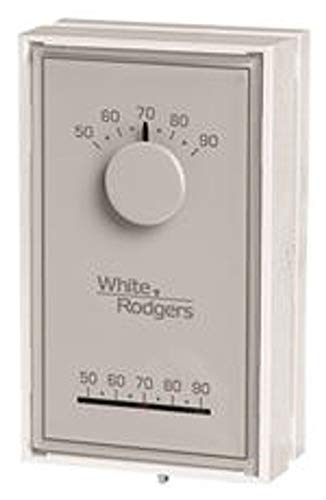
The Emerson 1E30N-910 is another excellent mechanical option that offers broad compatibility for various heating setups. This versatile thermostat can handle everything from standard heat-only systems to millivolt systems, making it a great choice for many older furnaces or gas fireplaces often found in garages or workshops. Its robust design is resistant to vibrations, which is a real plus in a busy garage environment, ensuring stable performance even with tools running. With a comfortable operating range, it’s perfect for maintaining that essential low temperature.
Key Features:
– Compatible with heat only systems, millivolt systems, and conventional oil/electric/gas systems.
– 50 – 90 Degree Fahrenheit operating range.
– Resistant to vibration.
– Mounts to wall or junction box.
– Classic white color.
Pros:
– Wide compatibility with various heating system types, including millivolt.
– Durable and vibration-resistant, ideal for garage settings.
– Simple, reliable mechanical operation – no programming needed.
– Easy to install on a wall or junction box.
Cons:
– No digital display or advanced programming options.
– The minimum temperature of 50°F might be slightly higher than some very low-temp applications.
User Impressions:
Customers often highlight the Emerson 1E30N-910’s versatility, especially its ability to work with millivolt systems, which can be tricky to find compatible thermostats for. Its robust build quality for the price point also receives frequent mentions, making it a favorite for practical applications like workshop temperature control.
ControlTemp CT72 Basic Tamper Proof Thermostat

For landlords, commercial property owners, or anyone needing to prevent unauthorized temperature changes, the ControlTemp CT72 is a game-changer. This basic tamper-proof thermostat offers a clever solution: it has fixed temperature limits that renters or guests cannot exceed for heat (72 degrees) or go below for AC (72 degrees). It’s a fantastic way to manage energy consumption and ensure that your heating system isn’t overused, providing peace of mind without constant supervision. It works with most common system types, making it a versatile choice for controlled environments.
Key Features:
– Tamper Proof Thermostat for landlord and commercial property owners.
– Renters/Guests can not set heat over 72 degrees.
– Renters/Guests can not set AC below 72 degrees.
– Works with most system types including Boiler, Furnace, Single Heat pumps.
Pros:
– Excellent for energy management in rental or commercial properties.
– Prevents unauthorized temperature adjustments by users.
– Compatible with a wide range of common heating and cooling systems.
– Simple interface for authorized users.
Cons:
– Fixed temperature limits (72°F) might be too high for a pure “low temp” garage application where lower minimums are desired.
– Not ideal for personal garage use where full control is preferred.
User Impressions:
Landlords absolutely love the ControlTemp CT72 for its effectiveness in preventing excessive heating or cooling costs. Users note that it successfully deters tenants from extreme temperature settings, leading to noticeable savings on utility bills. Its straightforward design also means less user confusion.
ControlTemp CT400 Advanced Tamper Proof Thermostat
Stepping up from the basic model, the ControlTemp CT400 Advanced offers even more control for landlords and property managers. This advanced tamper-proof thermostat allows the owner to set customizable heat and cool set points using a secure code, rather than fixed limits. This flexibility is a huge advantage for specific property requirements or varying seasons. It includes practical features like backup batteries to maintain settings during power outages and even service reminders for filter changes. It’s a highly intelligent solution for managing garage heating in a controlled, responsible way.
Key Features:
– Tamper Proof Thermostat for landlords and commercial property owners.
– Adjustable Landlord Set Heat and Cool Set points.
– Works with most system types, including Boilers, Furnace, and Single Stage Heat Pumps.
– Does not work with Multi Stage Systems or Electric Baseboard systems.
– Non-programmable.
– Customizable Security Code for landlord to set Heat and Cool Set Points – No Reset Button.
– Backup Batteries – Operates during power failures.
– Coming Soon Exclusive Access to Secure Owner Website for Security Information, Security Code Registration and Videos.
– Thermostat fully functional without access to Secure Owner Website and without registration.
– Service Reminders (Filter changes).
– Control type: Button Control.
– Item shape: Rectangular.
Pros:
– Customizable tamper-proof temperature limits via a security code.
– Backup batteries ensure continued operation during power failures.
– Includes helpful service reminders for maintenance.
– Compatible with a wide array of single-stage systems.
Cons:
– Not compatible with multi-stage systems or electric baseboard heating.
– Higher price point than basic models due to advanced features.
– Still designed for managed properties, not typical home garage use.
User Impressions:
Owners appreciate the flexibility of setting their own temperature limits on the CT400, a significant upgrade from fixed-limit models. The battery backup is a frequently praised feature, offering genuine peace of mind during outages. Many find the customizable security code easy to manage after initial setup.
L.B. White 09454 Thermostat Kit for Propane/NG Heaters

This isn’t a general-purpose low temp garage thermostat but a specialized kit designed to work seamlessly with specific L.B. White agricultural forced air box heaters. If you own one of these powerful propane or natural gas heaters, this thermostat kit is what you need for optimal temperature control. It comes pre-wired for easy integration, featuring a robust NEMA 4x enclosure that protects it from dust, water, and corrosion – perfect for demanding environments like barns, workshops, or, yes, even larger garages with specific heating needs. It’s built for durability and precision when paired with compatible units.
Key Features:
– NOT Compatible with 2.0 LB White Heaters.
– 1-foot power cord with a 3 prong plug.
– Pre-wired with spade connections.
– Compatible with most DSI (direct spark ignition) and HSI (hot surface ignition) L.B. White agricultural forced air box heater models.
– NEMA 4x enclosure.
Pros:
– Perfect, integrated temperature control solution for compatible L.B. White heaters.
– Extremely durable NEMA 4x enclosure for harsh environments.
– Pre-wired for straightforward installation and setup.
– Designed for precise control of specific agricultural/industrial heaters.
Cons:
– Highly specialized and only compatible with L.B. White heaters (check models carefully).
– Not a standalone thermostat for general HVAC systems.
– The 1-foot power cord might require an extension depending on heater placement.
User Impressions:
Owners of compatible L.B. White heaters consistently state that this kit is essential for proper temperature regulation. They appreciate the durable construction and the ease of installation, noting that it integrates perfectly with their existing heating setup, especially in large workshops or agricultural buildings.
Frequently Asked Questions (FAQ)
Q1: Why should I install a low temp garage thermostat instead of just using my regular home thermostat?
A: A standard home thermostat isn’t typically designed for the lower temperature ranges often desired in a garage. A specialized low temp garage thermostat allows you to set a minimum temperature (e.g., 40-50°F) for frost protection and energy savings, without unnecessarily heating the space to a comfortable indoor living temperature of 68-72°F. This prevents frozen pipes, protects tools, and keeps energy bills lower.
Q2: What’s the ideal temperature to set my garage thermostat to in winter?
A: This depends on your needs. For basic frost protection (to prevent pipes from freezing), 40-45°F is often sufficient. If you use your garage as a workshop or want a more comfortable environment, 50-55°F might be better. Keep in mind that every degree higher will increase your energy consumption.
Q3: Are mechanical or digital thermostats better for a garage?
A: Both have their place! Mechanical thermostats (like the Honeywell or Emerson models reviewed) are durable, reliable, and don’t require batteries for their core function, making them great for basic, set-it-and-forget-it temperature control in a rugged garage environment. Digital thermostats (often not “low temp” specific, but some programmable ones exist) offer more precise control, programming features, and often a clearer display, but they typically require batteries and can be more sensitive to dust/moisture. For a simple, robust low-temp solution, mechanical is often preferred.
Q4: Can I install a low temp garage thermostat myself?
A: For basic, low-voltage mechanical thermostats, many DIY enthusiasts can handle the installation, especially if replacing an existing thermostat. However, always turn off power to your heating system at the breaker first. If you’re dealing with line voltage, a complex system, or are unsure about wiring, it’s always safest to consult a qualified electrician or HVAC professional to ensure proper and safe installation.
Q5: What does “millivolt system compatible” mean?
A: A millivolt system (also known as a self-powered system) generates its own electricity to operate, typically found in older furnaces, wall heaters, or gas fireplaces. These systems require a thermostat specifically designed for millivolt compatibility, as regular 24V thermostats won’t work. The Emerson 1E30N-910 is a good example of a millivolt-compatible low temp garage thermostat.
Q6: How do tamper-proof thermostats work, and are they suitable for a garage?
A: Tamper-proof thermostats (like the ControlTemp models) are designed to prevent unauthorized users from changing temperature settings. They often feature fixed temperature limits or require a security code for adjustments. While primarily used in rental or commercial properties to control energy costs, they could be suitable for a garage if you want to prevent others (e.g., children, employees) from excessively heating or cooling the space, ensuring your chosen “low temp” setting remains untouched.
Q7: What’s the importance of an NEMA 4x enclosure on a thermostat?
A: A NEMA 4x enclosure (seen on the L.B. White thermostat kit) indicates a high level of protection against dust, dirt, hose-directed water, and corrosion. This is crucial for thermostats in harsh environments like agricultural settings, very dusty workshops, or garages where water might be present (e.g., from car washing or leaks). It ensures the internal components are shielded, extending the thermostat’s lifespan and reliability.

